1/6
Export Ready

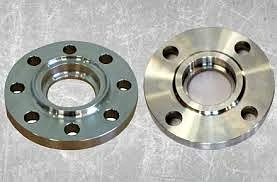
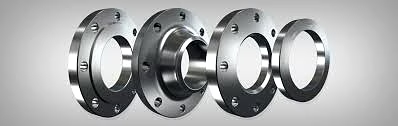
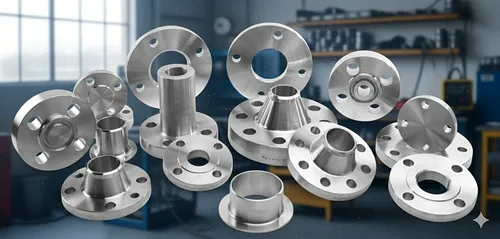
steel Flanges in all grades 304,316,330,410,etc

Sold by parmeswar steel industries · Manufacturer, Exporter · Mumbai, Maharashtra, India

Price
Price on request
In stock
Minimum order: 1 Unit

Export Snapshot

MOQ
1 Unit
Lead time
On request
Packaging
Standard export packaging
Shelf life / longevity
As per product specification
HS Code
73072100
Origin
India
Port of dispatch
On request
Export markets served
Global markets
Values shown are for parmeswar steel industries.
Compliance & Certifications
Suitable for

Importers · Distributors · Wholesalers

Know your supplier

parmeswar steel industries is a Manufacturer, Exporter based in Mumbai Maharashtra India.

Mumbai Dispatch on request Verified seller
parmeswar steel industries logo

Manufacturer, Exporter · Mumbai, Maharashtra, India

Registered address: Mumbai, India. Industry: Metals, Minerals & Resources > Metals, Metal Products & Alloys.

Established
Not shared
Employees
GST
27AXHPP7538E1Z5
IEC code
Not shared
Export markets
Global markets
GlobalLinker Member Since
Jun 2026
Turnover
Incorporation Type
On request
Product details

What are the specifications of this product?

Overview

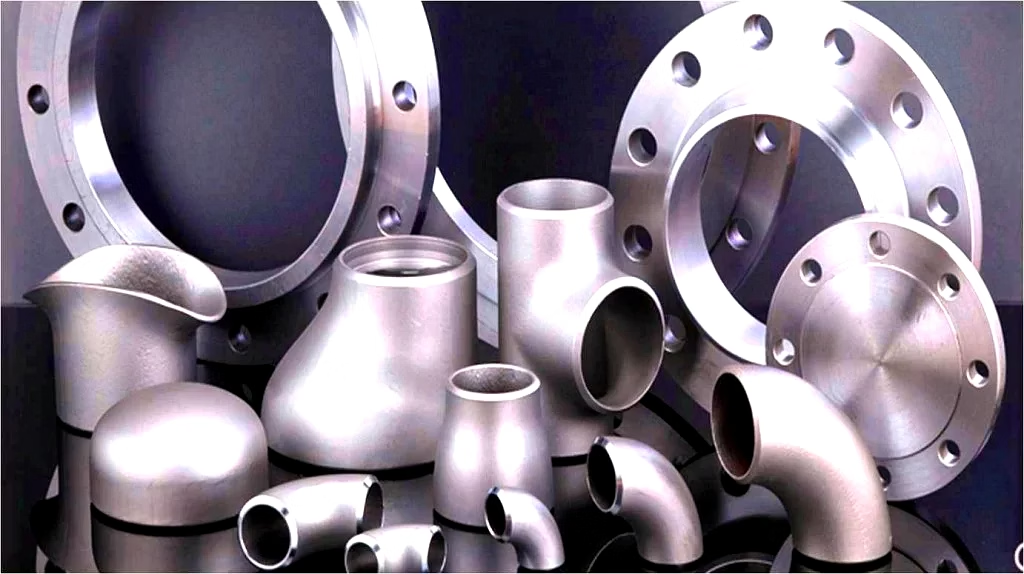
1. Core Types of FlangesDifferent flange configurations are selected based on the pressure, temperature, and mechanical stress of the piping system:Weld Neck (WN): Features a long tapered hub that is butt-welded to the pipe. Excellent for high-pressure, severe-velocity, or extreme temperature fluctuations.Slip-On (SO): Slipped over the pipe and welded both inside and outside. Easier to align than WN but offers less mechanical strength under cyclic loading.Blind (BL): A solid disc used to seal or block off the end of a piping system or vessel. Subject to high mechanical stress from internal pressure.Socket Weld (SW): The pipe fits into a counterbore and is fillet-welded from the outside. Typically restricted to smaller sizes (up to 2") in high-pressure applications.Lap Joint (LJ): Used in conjunction with a stub end. The flange slips over the pipe but is not welded; instead, it backs up the stub end. Perfect for systems requiring frequent dismantling and cleaning.Threaded (TH): Attached to the pipe via matching threads without structural welding. Ideal for low-pressure, ambient-temperature systems or where welding is hazardous.2. Size and Pressure FrameworksFlanges are universally manufactured according to specific dimension standards:Dimensional StandardsASME/ANSI B16.5: Covers nominal pipe sizes (NPS) from

Product Description

1. Additional & Specialty Flange Types

Beyond the core standard configurations, specialized piping systems require distinct physical designs:

  • Orifice Flanges: Used exclusively alongside orifice meters to measure the flow rate of liquids or gases in a pipeline. They come as a pair with pre-drilled machined "tapping" holes in the flange ring for pressure instrument connections.

  • Reducing Flanges: Designed to change pipeline sizes smoothly. The flange has a larger nominal connecting diameter (matching the larger pipe) but a smaller inner bore size to weld or slip onto a smaller line. It is a compact alternative to using a standard flange plus a pipe reducer.

  • Long Weld Neck (LWN) / Barrel Flanges: Similar to a standard Weld Neck, but the hub is elongated to act as a straight nozzle. These are widely used in high-pressure vessels, heavy-duty refinery columns, and boiler nozzles where reinforcing the opening is critical.

  • Spectacle Blind / Line Blind: Technically a piping component clamped between two standard flanges. It consists of one solid disc (to isolate a line) and one open ring (for normal flow) connected by a steel web. It allows operators to visually verify absolute line isolation during maintenance.

Flange Face Profiles

A flange's face style dictates the type of gasket used and its pressure threshold:

  • Flat Face (FF): The entire flange surface is flat. Used for cast iron or low-pressure ductile systems to avoid cracking the flange when tightening bolts.

  • Raised Face (RF): Features a small step raised surface around the bore ($1/16"$ for Class 150/300; $1/4"$ for higher classes). It concentrates bolt pressure onto a smaller gasket area for a tighter seal.

  • Ring Type Joint (RTJ): Features deep machined concentric grooves designed for solid metallic rings (oval or octagonal). Built exclusively for extreme high-pressure, high-temperature service (Class 600 and up).

2. Expanded Material Grades Reference

Carbon & Alloy Steels (For Reference Alignment)

  • ASTM A105: The ultimate standard for forged carbon steel flanges in ambient to high-temperature pressure systems.

  • ASTM A350 LF2 / LF3: Carbon/Alloy steel formulated explicitly for low-temperature structural duties (down to $-46^\circ\text{C}$ for LF2).

  • ASTM A182 F11 / F22 / F91: Chrome-Moly alloy steels. Engineered for outstanding creep resistance (resisting deformation under high heat) in high-temperature power plant steam lines and oil refineries.

Comprehensive Stainless Steels (SS)

Austenitic Upgrades

  • 317L: Higher Molybdenum content (3–4%) than 316L. Offers vastly improved pitting resistance and is widely used in paper mills, chemical processing, and flue-gas desulfurization plants.

  • 321 / 347: Stabilized stainless steels. Grade 321 uses Titanium and Grade 347 uses Niobium. This eliminates chromium carbide precipitation during welding, making them ideal for long-term service in the $425^\circ\text{C}$ to $815^\circ\text{C}$ sensitization temperature range.

  • 904L: A highly alloyed austenitic stainless steel with added Copper. Designed specifically for severe handling of sulfuric acid across varying concentrations.

Duplex & Super Duplex (High Strength + Pitting Resistance)

  • Duplex F51 (UNS S31803 / S32205): A 50/50 mixed microstructure of austenite and ferrite. It provides double the mechanical yield strength of standard 316L along with excellent resistance to chloride stress corrosion cracking.

  • Super Duplex F53 / F55 (UNS S32750 / S32760): Highly alloyed with Chromium, Molybdenum, and Nitrogen. Engineered for brutal marine, offshore subsea, and highly aggressive chemical processing lines.

Martensitic & Ferritic Options

  • 430: A plain chromium ferritic grade. Offers good corrosion resistance to nitric acid and atmospheric gases, combined with good formability.

  • 420: Higher carbon variant of 410, providing maximum hardened capability for high-wear internal valves and backing plates.

3. Advanced Superalloys & Hastelloy Expand

When system chemistry or heat destroys standard stainless steel, nickel-based superalloys become mandatory:

Hastelloy Portfolio

  • Hastelloy C276 (UNS N10276): Highly versatile across oxidizing and reducing environments. Unmatched resistance to localized pitting and stress corrosion cracking.

  • Hastelloy C22 (UNS N06022): Better overall corrosion protection than C276 in aggressive oxidizing media, particularly where ferric/cupric chlorides, wet chlorine, or nitric acids are present.

  • Hastelloy B3 (UNS N10675): Outstanding resistance to pure Hydrochloric acid ($\text{HCl}$) at all concentrations and temperatures. Unlike older B2 alloys, B3 has high thermal stability, meaning it doesn't lose structural integrity during welding fabrication.

Other Vital Superalloys

  • Inconel 625: A Nickel-Chromium-Molybdenum alloy with Niobium. Resists high-temperature scaling and oxidation up to $980^\circ\text{C}$ with immense mechanical strength. Perfect for exhaust systems and offshore marine components.

  • Inconel 825: High iron content compared to 625, specialized for resisting sulfuric and phosphoric acids.

  • Monel 400 (Nickel-Copper): Highly resistant to sea water, hydrofluoric acid ($\text{HF}$), and alkalies. Extensively utilized in marine engineering and salt refinery production.

  • Titanium Gr. 2 / Gr. 5: Exceptional strength-to-weight ratio and completely immune to corrosion from seawater or wet chlorine gases.

Expanded Material Matrix

Material FamilyFlange Forging Grade CodeKey Chemical CharacteristicBest Environment Match
High Heat AusteniticASTM A182 F321 / F347Titanium / Niobium StabilizedExhaust manifolds, high-temp steam boiler lines ($425\text{--}815^\circ\text{C}$)
Sulfuric Acid SpecASTM A182 F904LHigh Ni + Mo + CopperPhosphoric and Sulfuric acid lines, fertilizer production
Duplex SSASTM A182 F51 (2205)50% Ferrite / 50% AusteniteHigh-pressure brackish water pipelines, chemical cargo tanks
Super Duplex SSASTM A182 F53 (2507)PREN $\ge 40$ (High Cr, Mo, N)Offshore desalination plants, subsea oil and gas extraction
Chrome-Moly AlloyASTM A182 F22 / F91Chromium & Molybdenum alloyedHigh-pressure power generation, cracking furnace lines
HCl Resistant NickelHastelloy B3High Nickel-MolybdenumHydrochloric acid processing and chemical reactors
Marine SuperalloyMonel 400Nickel-Copper formulationMarine splash zones, sour gas lines, chemical alkylation plants

Description provided by parmeswar steel industries.

Specifications

Product Name steel Flanges in all grades 304,316,330,410,etc
Material Steel
Grades 304, 316, 330, 410, etc.
Flange Types Weld Neck (WN), Slip-On (SO), Blind (BL), Socket Weld (SW), Lap Joint (LJ), Threaded (TH)
Specialty Flange Types Orifice Flanges, Reducing Flanges, Long Weld Neck (LWN) / Barrel Flanges, Spectacle Blind / Line Blind
Face Profiles Flat Face (FF), Raised Face (RF)
Dimensional Standard ASME/ANSI B16.5
MOQ 1 Unit
Applications Piping systems, pressure systems, flow measurement, vessel isolation, refinery columns, boiler nozzles
Industries Process plants, refineries, boilers, mechanical installations, EPC, MRO
Pressure / Temperature Suitability High-pressure, low-pressure, ambient-temperature, severe-velocity, extreme temperature fluctuation applications

Use cases

Category Steel Flanges
Primary application Wholesale, distribution, and international sourcing
Brand Not specified
Product type Product

Logistics & handling

Lead time On request
Packaging As per buyer requirement
Storage condition As recommended by supplier
Origin India
Form As listed by supplier

Commercials (this seller)

Minimum order 1 Unit
Lead time On request
Payment terms As per negotiated commercial agreement.
Checkout type enquiry
Buyer questions

Frequently asked by buyers

Common questions B2B buyers ask before sourcing steel Flanges in all grades 304,316,330,410,etc. Answers compiled from verified sellers' commercial terms and platform data.

Q: What flange types are available for this product line?
A: The product line includes Weld Neck, Slip-On, Blind, Socket Weld, Lap Joint, and Threaded flanges, along with specialty options such as Orifice, Reducing, Long Weld Neck, and Spectacle Blind / Line Blind types.
Q: Which material grades are offered?
A: The listed grades include 304, 316, 330, and 410, with additional grades indicated by "etc."
Q: What dimensional standard do these flanges follow?
A: These flanges are referenced to ASME/ANSI B16.5, a widely used dimensional standard for industrial flange applications.
Q: Are these flanges suitable for high-pressure applications?
A: Yes. The product includes high-pressure suitable types such as Weld Neck, Socket Weld, and Long Weld Neck flanges, which are typically selected for demanding piping and vessel connections.
Q: Can these flanges be used for flow measurement systems?
A: Yes. Orifice Flanges are specifically used with orifice meters and include tapping holes for pressure instrument connections.
Q: What face profiles are supported?
A: The listed face profiles are Flat Face (FF) and Raised Face (RF), allowing buyers to match gasket and pressure requirements.
Q: What is the minimum order quantity?
A: The MOQ is 1 unit, which supports sample buying, maintenance replacement, and small project procurement.
Q: Which industries commonly use these flanges?
A: They are suitable for process plants, refineries, boiler systems, mechanical installations, EPC projects, and MRO maintenance work.
Question not answered? Ask sellers directly — typical response within 4 hours.
steel Flanges in all grades 304,316,330,410,etc
Price on request · MOQ 1Unit