1/5
Export Ready

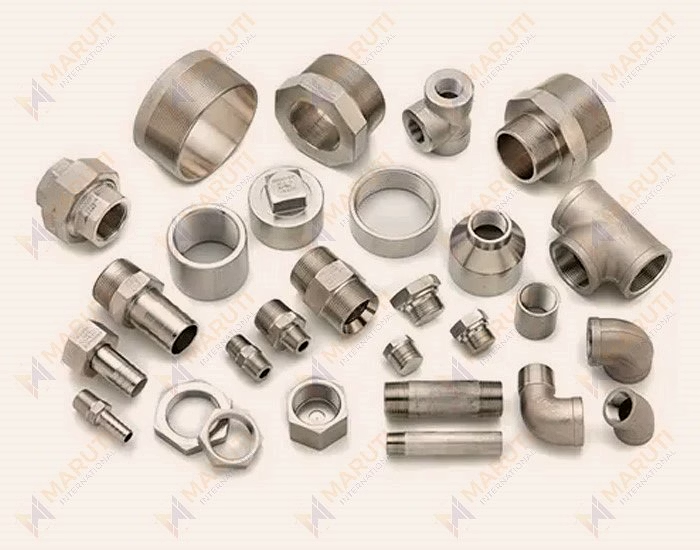
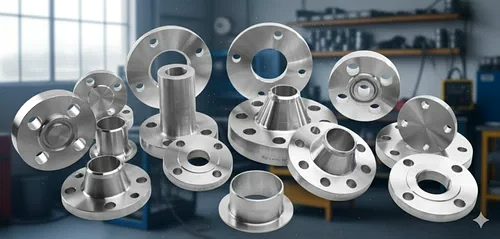
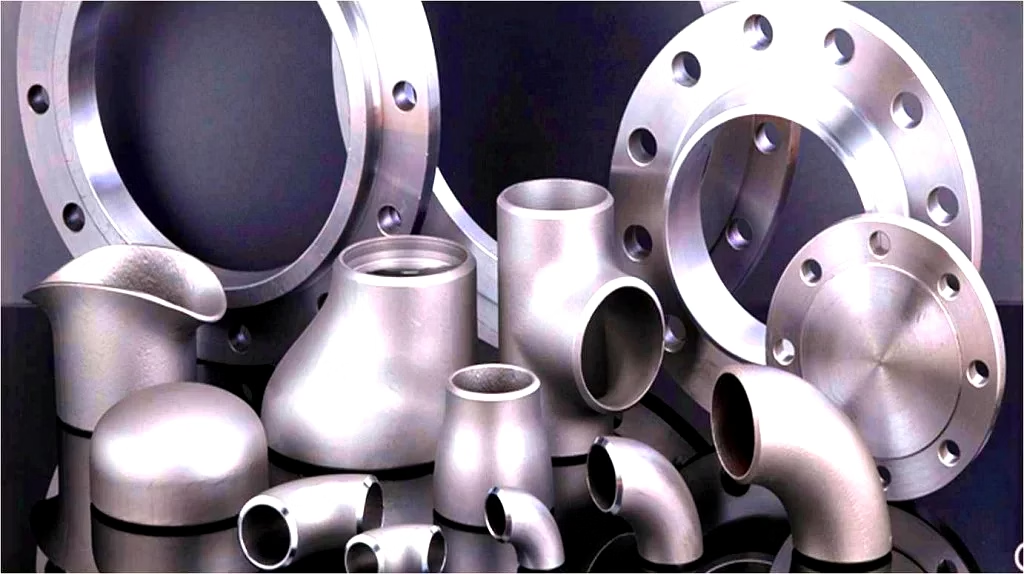
steel fittings like elbow, Tee, Reducer, couplings etc

Sold by parmeswar steel industries · Manufacturer, Exporter · Mumbai, Maharashtra, India

Price
Price on request
In stock
Minimum order: 1 Unit

Export Snapshot

MOQ
1 Unit
Lead time
On request
Packaging
Standard export packaging
Shelf life / longevity
As per product specification
HS Code
73072200
Origin
India
Port of dispatch
On request
Export markets served
Global markets
Values shown are for parmeswar steel industries.
Compliance & Certifications
Suitable for

Importers · Distributors · Wholesalers

Know your supplier

parmeswar steel industries is a Manufacturer, Exporter based in Mumbai Maharashtra India.

Mumbai Dispatch on request Verified seller
parmeswar steel industries logo

Manufacturer, Exporter · Mumbai, Maharashtra, India

Registered address: Mumbai, India. Industry: Metals, Minerals & Resources > Metals, Metal Products & Alloys.

Established
Not shared
Employees
GST
27AXHPP7538E1Z5
IEC code
Not shared
Export markets
Global markets
GlobalLinker Member Since
Jun 2026
Turnover
Incorporation Type
On request
Product details

What are the specifications of this product?

Overview

Stainless Steel & Alloy Fittings: A Brief GuidePipe fittings are components used to connect, redirect, size, or terminate fluid and gas piping systems. Below is a breakdown of the primary fitting types, followed by the material grades used to withstand various pressures, temperatures, and corrosive environments.1. Primary Fitting Types & FunctionsElbow (90° & 45°): Used to change the direction of piping.Tee (Equal & Reducing): A T-shaped fitting with three openings. An equal tee keeps the same line size, while a reducing tee branches off into a smaller pipe diameter.Reducer (Concentric & Eccentric): Alters the pipe size. Concentric reducers maintain a center-line alignment (ideal for vertical lines), while eccentric reducers feature an offset flat side to prevent air pockets (essential in horizontal suction lines).Coupling: A short sleeve used to connect two pipes of the same size. Available as full couplings or half-couplings.Socket / Socket Weld: Fittings featuring a recessed area where the pipe is inserted before being fillet-welded. Excellent for high-pressure, small-diameter piping.Rings / Backing Rings / Collars: Used in conjunction with stub ends or slip-on flanges to facilitate alignment and joint stability in high-vibration systems.Nipples, Plugs, & Caps: Nipples extend a line over short distances, plugs seal threaded pipe ends, and caps weld onto raw pipe ends to close the system.2. Stainless Steel GradesStainless steels are iron-based alloys containing a minimum of $10.5\%$ chromium, which provides an invisible, self-healing oxide layer for corrosion resistance.Grade FamilySpecific GradesKey Properties & Common ApplicationsAustenitic (Most Common)304 / 304LThe standard "18/8" stainless steel. Excellent formability and general corrosion resistance. Used in commercial piping, food processing, and architectural applications.316 / 316LContains $2\text{--}3\%$ molybdenum, significantly improving resistance to chlorides (pitting) and marine environments. Standard for chemical processing.310 / 310SHigh-chromium and high-nickel grade designed for excellent oxidation resistance in high-temperature environments (up to $1100^\circ\text{C}$), like furnace parts.Martensitic440 (A, B, C)High-carbon chromium steel. Extremely hard, wear-resistant, and high strength, though it offers lower corrosion resistance than austenitic grades. Used for high-wear valve components.Super Austenitic904L (Often noted as 930 series variant)Low-carbon, high-alloy austenitic steel with added copper. Exceptionally resistant to strong reducing acids like sulfuric acid and highly concentrated chloride environments.3. Exotic Alloys & High AlloysWhen standard stainless steels fail due to extreme heat, severe acidity, or intense stress-corrosion cracking, high alloys and exotic non-ferrous metals are deployed.Nickel AlloysHastelloy (e.g., C-276, B-3): A nickel-molybdenum-chromium alloy family famous for outstanding resistance to severely corrosive chemicals, including wet chlorine gas, ferric chlorides, and strong oxidizing acids.Monel (e.g., Monel 400): A nickel-copper alloy that exhibits high strength and remarkable resistance to seawater, hydrofluoric acid, sulfuric acid, and alkalis. Widely utilized in marine engineering and chemical processing.Inconel (e.g., 600, 625, 718): Nickel-chromium-iron alloys engineered for extreme high-temperature stability and oxidation resistance. They maintain high tensile strength under heat cycles where steel would deform.Titanium & Special MetalsTitanium (Grades 2, 5): Features an incredible strength-to-weight ratio and absolute immunity to ambient seawater corrosion. Excellent for aerospace, highly specific chemical handling, and desalination plants.4. End Connections (How they join)Depending on the pressure ratings and structural requirements, these fittings are engineered for three main connection types:Butt-Weld (BW): The pipe and fitting ends are beveled and welded directly edge-to-edge. Used for permanent, leak-proof joints in medium-to-high pressure systems.Socket-Weld (SW): Pipes slide into a socket shoulder and are welded externally. Standard for high-pressure, small-diameter pipelines.Threaded (NPT / BSP): Screwed together without welding. Typically used in low-pressure, non-critical commercial utilities where maintenance disassembly is required.

Product Description

1. Seamless vs. Welded Fittings

Fittings are manufactured using two primary methods, fundamentally impacting their pressure ratings, cost, and applications.

       SEAMLESS FITTING                      WELDED FITTING
    (From Extrusive Tube)                 (From Formed Plate)
   
       .--------------.                     .--------------.
      /                \                   /       ||       \
     |      Smooth      |                 |    Weld||Seam    |
     |    Continuous    |                 |        ||        |
      \                /                   \       ||       /
       '--------------'                     '--------------'

Seamless Fittings

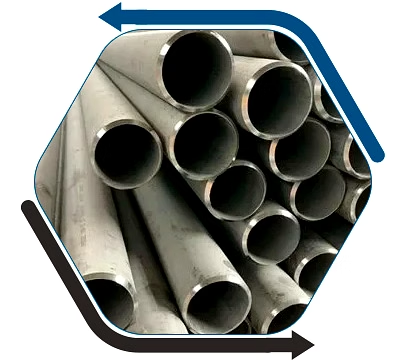
  • Manufacturing: Made from seamless pipes or by heating a solid billet and piercing/extruding it over a mandrel into the fitting shape (e.g., mandrel-drawing for elbows).

  • Characteristics: No welded seams or joints anywhere in the body. This eliminates the risk of a weak point or preferential corrosion along a weld line.

  • Pressure Rating: Generally $100\%$ joint efficiency factor, meaning they can handle significantly higher working pressures and extreme thermal cycling.

  • Applications: Critical, high-pressure, high-temperature, or ultra-hazardous lines (e.g., high-pressure steam, oil and gas exploration, nuclear reactors).

Welded Fittings (ERW / EFW)

  • Manufacturing: Formed from flat stainless steel plates, sheets, or strips that are rolled into shape (like a half-shell or cylinder) and then welded along the longitudinal seam.

  • Characteristics: Visible internal and external weld bead, though premium fittings undergo bead-rolling and annealing to make the seam as homogenous with the parent metal as possible.

  • Pressure Rating: Typically calculated with a joint efficiency factor (often $0.85$ unless $100\%$ X-ray/radiography tested).

  • Applications: Larger diameter piping networks ($8\text{"}$ and above), low-to-medium pressure applications, and structural or commercial fluid transportation where seamless construction would be cost-prohibitive.

2. Expanded Stainless Steel Grade Directory

Beyond the basic 304 and 316, the industrial landscape utilizes highly specialized sub-families to combat specific mechanical and thermal stresses.

Duplex & Super Duplex Stainless Steels

These feature a balanced $50/50$ microstructure of Austenitic and Ferritic steel, offering double the mechanical strength of standard 316, alongside exceptional resistance to stress corrosion cracking (SCC) and pitting in high-chloride environments.

  • Duplex 2205 (UNS S31803 / S32205): The workhorse of duplex grades. Ideal for marine chemical tankers, desalination plants, and oil refining.

  • Super Duplex 2507 (UNS S32750): Higher chromium ($25\%$), molybdenum ($4\%$), and nitrogen content. Built for highly aggressive chemical processes and deep-sea subsea equipment.

Premium Austenitic Grades (High Heat & High Carbon Variations)

  • 321 / 321H: Stabilized with Titanium. The titanium binds with carbon to prevent chromium carbide precipitation during welding, making these fittings ideal for prolonged service in the $425\text{--}815^\circ\text{C}$ temperature range (e.g., aircraft exhaust stacks, heat exchangers).

  • 347 / 347H: Similar to 321, but stabilized with Columbium (Niobium) and Tantalum to resist intergranular corrosion under extreme high-temperature environments.

  • 317L: A higher molybdenum variant of 316L ($3\text{--}4\%$). It offers superior resistance to chemical attack by sulfurous gases and organic acids.

Ferritic Stainless Steels (Magnetic & Economic)

  • 409 / 410: Lower-alloyed chromium steels that are magnetic. While they offer lower corrosion resistance than the 300 series, they possess excellent thermal fatigue properties. They are widely used in automotive exhaust systems and structural frameworks where cosmetic appearance isn't critical.

3. Expanded Exotic Alloys & Superalloys Directory

When conditions exceed the thermal and chemical limits of even Super Duplex steels, superalloys are deployed.

┌──────────────────────────────────────────────────────────┐
│              SUPERALLOY CORROSION MATRIX                │
├──────────────┬───────────────────────────────────────────┤
│ HASTELLOY    │ Best for strong oxidizing/reducing acids  │
├──────────────┼───────────────────────────────────────────┤
│ MONEL        │ Best for Hydrofluoric acid & Seawater     │
├──────────────┼───────────────────────────────────────────┤
│ INCONEL      │ Best for Extreme High-Temp Oxidation     │
└──────────────┴───────────────────────────────────────────┘

High-Nickel & Specialized Alloys

  • Alloy 20 (Carpenter 20): Often classified between a stainless steel and a nickel alloy. It was specifically formulated to resist sulfuric acid attack. Fittings in Alloy 20 are heavily utilized in pharmaceutical, plastics, and synthetic fiber manufacturing.

  • Incoloy (e.g., Incoloy 800/800H/825): Nickel-iron-chromium alloys. While Inconel is primarily nickel-based, Incoloy contains a higher percentage of iron, making it more cost-effective while still maintaining excellent oxidation resistance and high-temperature structural integrity.

  • Cupro-Nickel (Copper-Nickel 70/30 & 90/10): Copper-based alloys containing $10\%$ to $30\%$ nickel. These fittings are distinct because they offer unparalleled resistance to bio-fouling (marine growth like barnacles) and macro-fouling in saltwater piping systems, alongside excellent ductility.

4. Key Specification & Manufacturing Standards

To tie these grades and configurations together, fittings are manufactured strictly according to global dimensions and material standards:

  • ASME B16.9: Factory-Made Wrought Buttwelding Fittings (Covers dimensions and tolerances for both seamless and welded variants).

  • ASME B16.11: Forged Fittings, Socket-Welding and Threaded (Covers high-pressure ratings like 2000#, 3000#, and 6000# lines).

  • ASTM A403: Standard Specification for Wrought Austenitic Stainless Steel Piping Fittings.

  • ASTM A815: Standard Specification for Wrought Ferritic, Ferritic/Austenitic (Duplex), and Martensitic Stainless Steel Piping Fittings.

Description provided by parmeswar steel industries.

Specifications

Product Name steel fittings like elbow, Tee, Reducer, couplings etc
Store Name PARMESWAR STEEL INDUSTRIES
Product Category metals and alloys > stainless steel
Minimum Order Quantity 1 Unit
Primary Function Connect, redirect, size, or terminate fluid and gas piping systems
Fitting Types Elbow (90° & 45°), Tee (Equal & Reducing), Reducer (Concentric & Eccentric), Coupling, Socket / Socket Weld, Rings / Backing Rings / Collars, Nipples, Plugs, Caps
Common Stainless Steel Grades 304, 304L, 316, 316L, 310, 310S, 440 (A, B, C), 904L
Exotic Alloy Materials Hastelloy, Monel, Inconel, Titanium
End Connection Types Butt-Weld (BW), Socket-Weld (SW), Threaded (NPT / BSP)
Manufacturing Types Seamless fittings, welded fittings
Seamless Manufacturing Method Made from seamless pipes or solid billet by piercing/extrusion over a mandrel
Welded Manufacturing Method Formed from flat stainless steel plates, sheets, or strips and welded along the longitudinal seam
Pressure Efficiency Seamless fittings: generally 100% joint efficiency; welded fittings: typically ~0.85 unless 100% radiography tested
Temperature Resistance 310/310S suitable for high-temperature environments up to 1100°C
Corrosion Resistance Chloride, marine, chemical, high-acid, and oxidation resistance depending on grade
Target Industries Chemical processing, marine engineering, food processing, oil and gas, nuclear, power generation, industrial piping
Supply Type Wholesale, bulk order, OEM, factory direct, export-ready

Use cases

Category Stainless Steel Pipe Fittings
Primary application Wholesale, distribution, and international sourcing
Brand Not specified
Product type Product

Logistics & handling

Lead time On request
Packaging As per buyer requirement
Storage condition As recommended by supplier
Origin India
Form As listed by supplier

Commercials (this seller)

Minimum order 1 Unit
Lead time On request
Payment terms As per negotiated commercial agreement.
Checkout type enquiry
Buyer questions

Frequently asked by buyers

Common questions B2B buyers ask before sourcing steel fittings like elbow, Tee, Reducer, couplings etc. Answers compiled from verified sellers' commercial terms and platform data.

Q: Which stainless steel grades are available for these fittings?
A: The provided product data mentions 304/304L, 316/316L, 310/310S, 440 series, and 904L, along with exotic alloy options such as Hastelloy, Monel, Inconel, and Titanium.
Q: What fitting types are included in this product line?
A: The range includes elbows, tees, reducers, couplings, socket and socket-weld fittings, rings, backing rings, collars, nipples, plugs, and caps.
Q: Which end connections can be supplied?
A: These fittings are available in butt-weld (BW), socket-weld (SW), and threaded connections using NPT or BSP threads.
Q: Are seamless and welded versions both available?
A: Yes. The product data describes both seamless fittings, made from seamless pipe or billet, and welded fittings formed from plates, sheets, or strips.
Q: What applications are these fittings suitable for?
A: They are suitable for fluid and gas piping systems in industries such as chemical processing, marine engineering, food processing, oil and gas, nuclear service, and power generation.
Q: What is the minimum order quantity?
A: The MOQ provided is 1 Unit.
Q: Are high-temperature applications supported?
A: Yes. The data specifically notes that 310/310S stainless steel is designed for high-temperature environments up to 1100°C.
Q: What is the supply advantage for B2B buyers?
A: The listing supports wholesale, bulk order, OEM, factory direct, and export-ready procurement with a low MOQ for small or urgent requirements.
Question not answered? Ask sellers directly — typical response within 4 hours.
steel fittings like elbow, Tee, Reducer, couplings etc
Price on request · MOQ 1Unit