1/6
Export Ready

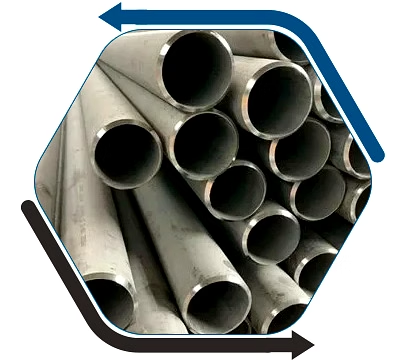
All Steel grades pipe 304/316/202/410/310 etc

Sold by parmeswar steel industries · Manufacturer, Exporter · Mumbai, Maharashtra, India

Price
Price on request
In stock
Minimum order: 1 Kilogram

Export Snapshot

MOQ
1 Kilogram
Lead time
On request
Packaging
Standard export packaging
Shelf life / longevity
As per product specification
HS Code
7304
Origin
India
Port of dispatch
On request
Export markets served
Global markets
Values shown are for parmeswar steel industries.
Compliance & Certifications
Suitable for

Importers · Distributors · Wholesalers

Know your supplier

parmeswar steel industries is a Manufacturer, Exporter based in Mumbai Maharashtra India.

Mumbai Dispatch on request Verified seller
parmeswar steel industries logo

Manufacturer, Exporter · Mumbai, Maharashtra, India

Registered address: Mumbai, India. Industry: Metals, Minerals & Resources > Metals, Metal Products & Alloys.

Established
Not shared
Employees
GST
27AXHPP7538E1Z5
IEC code
Not shared
Export markets
Global markets
GlobalLinker Member Since
Jun 2026
Turnover
Incorporation Type
On request
Product details

What are the specifications of this product?

Overview

Seamless PipesHow it’s made: Manufactured by piercing a solid billet of steel to form a hollow tube, then extruding or drawing it to size. It has no welded seam.Key Benefits: Higher pressure ratings, excellent uniformity, and zero risk of weld defects.Best For: High-pressure, high-temperature, or critical environments (e.g., oil and gas, chemical processing).Welded PipesHow it’s made: Formed by rolling a flat strip or plate of steel into a cylinder and welding the seam longitudinally.Key Benefits: More cost-effective, precise wall thickness, and available in larger diameters.Best For: Low to medium-pressure applications, architectural structures, and general fluid transport.2. Key Stainless Steel GradesStainless steel is broadly categorized into series based on its crystalline structure and alloying elements.Austenitic Series (300 & 200 Series) - Most CommonGrade 304: The industry standard ("18/8" stainless). Excellent corrosion resistance and formability. Used in food processing, brewing, and everyday piping.Grade 316: Contains added Molybdenum (usually 2-3%), which gives it superior resistance to chlorides and pitting. Essential for marine environments, chemical plants, and pharmaceuticals.Grade 202: A lower-cost alternative where Manganese and Nitrogen replace some of the Nickel. It has decent strength but significantly lower corrosion resistance than 304. Best for indoor decorative or low-exposure use.Martensitic & Ferritic Series (400 Series)Grade 410: A basic martensitic grade containing 11.5% Chromium. It is magnetic and can be heat-treated for high hardness and strength, but its corrosion resistance is lower than the 300 series. Used for high-stress parts, valves, and petrochemical applications.3. High-Nickel & "Percentile" AlloysWhen standard stainless steel fails due to extreme heat, severe acids, or immense stress, high-nickel superalloys (often referred to based on their high elemental percentages) are used.Alloy FamilyKey CharacteristicsTypical ApplicationsHastelloy (e.g., C-276, C-22)High percentage of Nickel, Molybdenum, and Chromium. Offers unmatched resistance to aggressive chemicals, wet chlorine gas, and strong acids.Chemical processing, pollution control, acid production.Inconel (e.g., 600, 625, 718)Nickel-Chromium based. Maintains its high tensile strength and oxidation resistance at extreme temperatures where standard steel would melt or warp.Aerospace, jet engines, nuclear reactors, gas turbines.Monel (e.g., 400, K-500)Nickel-Copper alloy. Highly resistant to seawater, hydrofluoric acid, and alkalis.Marine engineering, piping exposed to brackish water, chemical valves.Duplex / Super Duplex (e.g., 2205, 2507)A 50/50 mix of Austenitic and Ferritic steel. Delivers double the strength of standard 304/316 and exceptional resistance to stress corrosion cracking.Desalination plants, offshore oil rigs, subs

Product Description

Let's expand the list with more specialized grades across different series, including the heat-resistant, titanium-stabilized, and high-purity variants often used in heavy industry.

1. Advanced Austenitic Grades (300 Series)

These are variations of the standard 300 series designed for high temperatures, specialized corrosion, or easier welding.

High-Temperature & Stabilized Grades

  • Grade 310 / 310S: Contains very high Chromium (25%) and Nickel (20%). It is the ultimate heat-resistant stainless steel grade, maintaining high oxidation resistance up to 1050°C.

    • Best For: Furnace piping, heat exchangers, and kilns.

  • Grade 321: Essentially 304 stainless but stabilized with Titanium. The titanium prevents carbide precipitation during welding at high temperatures (425–850°C), protecting the pipe from intergranular corrosion.

    • Best For: Aircraft exhaust manifolds, boiler casings, and high-temp chemical processing.

  • Grade 347: Similar to 321, but stabilized with Niobium (Columbium) instead of titanium. It handles high-temperature environments slightly better in highly oxidizing conditions.

Low Carbon ("L") Variants

  • Grade 304L & 316L: The "L" stands for low carbon (maximum 0.03% vs 0.08% standard). Lowering the carbon eliminates the risk of weld decay, making these the standard choice for any heavy-gauge welded piping networks where post-weld annealing isn't possible.

2. Ferritic & Martensitic Grades (400 Series)

These grades generally contain Chromium but little to no Nickel, making them magnetic and cost-effective.

  • Grade 430: A classic ferritic grade. It is magnetic and offers useful corrosion resistance against mild atmospheric exposure and some acids. It doesn't handle structural stresses or welding as well as the 300 series.

    • Best For: Decorative trim, appliance lines, and non-critical automotive exhaust.

  • Grade 409: A low-cost ferritic grade stabilized with titanium, specifically optimized for heat tolerance and basic rust protection.

    • Best For: Automotive silencers, catalytic converter shells, and exhaust pipes.

  • Grade 420: A higher-carbon version of 410. It can be heat-treated to a very high hardness but exhibits lower ductility. Rarely used for fluid piping, but highly utilized for instrument tubing and valve internals.

3. "Super" Austenitic & Specialty Cr-Ni Grades

When standard 316L isn't enough, but a full-scale Nickel alloy like Hastelloy is over-budget, these bridge the gap.

  • Grade 904L: A super-austenitic carbon grade with added Copper. This copper content gives it tremendous resistance to strong reducing acids like sulphuric acid across a wide range of concentrations.

    • Best For: Acid processing plants, oil refinery piping, and seawater cooling systems.

  • Alloy 20 (Carpenter 20): Specifically designed for maximum resistance to sulphuric acid attack. It contains high amounts of Nickel, Chromium, Molybdenum, and Copper.

    • Best For: Mixing tanks, chemical pickling lines, and pharmaceutical manufacturing line components.

Quick Reference Summary

Grade FamilyKey ElementsMain FeaturePrimary Application
310S25% Cr, 20% NiExtreme High-Temperature Scale ResistanceFurnace tubes, Kiln liners
321Cr-Ni + TitaniumPrevents weld decay at high tempsAerospace, high-heat exhaust
304L / 316LLow CarbonMaximum weldability without rust riskStructural & heavy fluid lines
43016-18% Cr (No Ni)Low cost, magnetic, basic resistanceTrim, light exhaust components
904LCr-Ni-Mo + CopperHigh resistance to Sulphuric AcidRefineries, chemical transport

Description provided by parmeswar steel industries.

Specifications

Product Name All Steel grades pipe 304/316/202/410/310 etc
Store Name PARMESWAR STEEL INDUSTRIES
Minimum Order Quantity 1 Kilogram
Primary Material Stainless steel
Pipe Type Seamless pipes
Alternate Pipe Type Welded pipes
Manufacturing Method Piercing a solid billet, then extruding or drawing
Seam Characteristics No welded seam
Available Grades 304, 316, 202, 410, 310, 310S, 321, 347, 430, 409, 420, 904L, Alloy 20
304 Grade Use Food processing, brewing, everyday piping
316 Grade Use Marine environments, chemical plants, pharmaceuticals
202 Grade Use Indoor decorative or low-exposure use
410 Grade Use High-stress parts, valves, petrochemical applications
310S Composition 25% Chromium, 20% Nickel
310S Heat Resistance Up to 1050°C oxidation resistance
321 Stabilization Titanium-stabilized
347 Stabilization Niobium-stabilized
304L / 316L Carbon Content Low carbon, maximum 0.03%
430 Grade Type Ferritic, magnetic
409 Grade Type Ferritic, titanium-stabilized
420 Grade Type Higher-carbon martensitic grade
904L Composition Cr-Ni-Mo with Copper
Alloy 20 Composition Nickel, Chromium, Molybdenum, Copper
Typical Applications Oil and gas, chemical processing, pharmaceuticals, food processing, brewing, marine systems, automotive exhaust, refineries, desalination, general fluid transport
Supply Type Wholesale / bulk order / OEM / factory direct / export-ready

Use cases

Category Stainless Steel Pipes
Primary application Wholesale, distribution, and international sourcing
Brand Not specified
Product type Product

Logistics & handling

Lead time On request
Packaging As per buyer requirement
Storage condition As recommended by supplier
Origin India
Form As listed by supplier

Commercials (this seller)

Minimum order 1 Kilogram
Lead time On request
Payment terms As per negotiated commercial agreement.
Checkout type enquiry
Buyer questions

Frequently asked by buyers

Common questions B2B buyers ask before sourcing All Steel grades pipe 304/316/202/410/310 etc. Answers compiled from verified sellers' commercial terms and platform data.

Q: Which stainless steel grades are available for this pipe range?
A: The product range includes 304, 316, 202, 410, 310, 310S, 321, 347, 430, 409, 420, 904L, and Alloy 20, along with low-carbon 304L and 316L variants.
Q: Is this pipe supplied as seamless or welded?
A: The listing describes seamless pipes as the primary construction, with welded pipe options also referenced for applications that require cost efficiency and larger diameters.
Q: What is the main advantage of the seamless pipe construction?
A: Seamless construction removes the welded seam, which gives better uniformity, higher pressure ratings, and eliminates weld-defect risk.
Q: What is the minimum order quantity for purchase?
A: The minimum order quantity is 1 kilogram, which supports both small trial orders and bulk procurement.
Q: Which grade is best for high-temperature service?
A: Grade 310S is highlighted as the heat-resistant option, with oxidation resistance up to 1050°C. Grades 321 and 347 are also suitable for elevated-temperature service.
Q: Which grades are suitable for corrosive or marine environments?
A: Grade 316 is recommended for chloride and marine exposure, while 904L and Alloy 20 are positioned for severe acid service and aggressive chemical environments.
Q: Can these pipes be used for food and pharmaceutical applications?
A: Yes. Grade 304 is described for food processing and brewing, and grade 316 is noted for pharmaceuticals and chemical plants.
Q: Are low-carbon grades available for welded piping networks?
A: Yes. 304L and 316L are included as low-carbon grades with maximum carbon content of 0.03%, which reduces the risk of weld decay in welded piping systems.
Question not answered? Ask sellers directly — typical response within 4 hours.
All Steel grades pipe 304/316/202/410/310 etc
Price on request · MOQ 1Kilogram