
Our Products
Showing 1-3 of 3 products
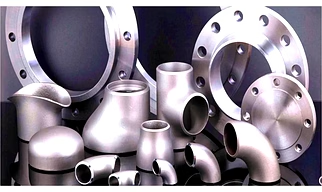
steel fittings like elbow, Tee, Reducer, couplings etc
Stainless Steel & Alloy Fittings: A Brief Guide
Pipe fittings are components used to connect, redirect, size, or terminate fluid and gas piping systems. Below is a breakdown of the primary fitting types, followed by the material grades used to withstand various pressures, temperatures, and corrosive environments.
1. Primary Fitting Types & Functions
Elbow (90° & 45°): Used to change the direction of piping.
Tee (Equal & Reducing): A T-shaped fitting with three openings. An equal tee keeps the same line size, while a reducing tee branches off into a smaller pipe diameter.
Reducer (Concentric & Eccentric): Alters the pipe size. Concentric reducers maintain a center-line alignment (ideal for vertical lines), while eccentric reducers feature an offset flat side to prevent air pockets (essential in horizontal suction lines).
Coupling: A short sleeve used to connect two pipes of the same size. Available as full couplings or half-couplings.
Socket / Socket Weld: Fittings featuring a recessed area where the pipe is inserted before being fillet-welded. Excellent for high-pressure, small-diameter piping.
Rings / Backing Rings / Collars: Used in conjunction with stub ends or slip-on flanges to facilitate alignment and joint stability in high-vibration systems.
Nipples, Plugs, & Caps: Nipples extend a line over short distances, plugs seal threaded pipe ends, and caps weld onto raw pipe ends to close the system.
2. Stainless Steel Grades
Stainless steels are iron-based alloys containing a minimum of $10.5\%$ chromium, which provides an invisible, self-healing oxide layer for corrosion resistance.
| Grade Family | Specific Grades | Key Properties & Common Applications |
| Austenitic (Most Common) | 304 / 304L | The standard "18/8" stainless steel. Excellent formability and general corrosion resistance. Used in commercial piping, food processing, and architectural applications. |
| 316 / 316L | Contains $2\text{--}3\%$ molybdenum, significantly improving resistance to chlorides (pitting) and marine environments. Standard for chemical processing. | |
| 310 / 310S | High-chromium and high-nickel grade designed for excellent oxidation resistance in high-temperature environments (up to $1100^\circ\text{C}$), like furnace parts. | |
| Martensitic | 440 (A, B, C) | High-carbon chromium steel. Extremely hard, wear-resistant, and high strength, though it offers lower corrosion resistance than austenitic grades. Used for high-wear valve components. |
| Super Austenitic | 904L (Often noted as 930 series variant) | Low-carbon, high-alloy austenitic steel with added copper. Exceptionally resistant to strong reducing acids like sulfuric acid and highly concentrated chloride environments. |
3. Exotic Alloys & High Alloys
When standard stainless steels fail due to extreme heat, severe acidity, or intense stress-corrosion cracking, high alloys and exotic non-ferrous metals are deployed.
Nickel Alloys
Hastelloy (e.g., C-276, B-3): A nickel-molybdenum-chromium alloy family famous for outstanding resistance to severely corrosive chemicals, including wet chlorine gas, ferric chlorides, and strong oxidizing acids.
Monel (e.g., Monel 400): A nickel-copper alloy that exhibits high strength and remarkable resistance to seawater, hydrofluoric acid, sulfuric acid, and alkalis. Widely utilized in marine engineering and chemical processing.
Inconel (e.g., 600, 625, 718): Nickel-chromium-iron alloys engineered for extreme high-temperature stability and oxidation resistance. They maintain high tensile strength under heat cycles where steel would deform.
Titanium & Special Metals
Titanium (Grades 2, 5): Features an incredible strength-to-weight ratio and absolute immunity to ambient seawater corrosion. Excellent for aerospace, highly specific chemical handling, and desalination plants.
4. End Connections (How they join)
Depending on the pressure ratings and structural requirements, these fittings are engineered for three main connection types:
Butt-Weld (BW): The pipe and fitting ends are beveled and welded directly edge-to-edge. Used for permanent, leak-proof joints in medium-to-high pressure systems.
Socket-Weld (SW): Pipes slide into a socket shoulder and are welded externally. Standard for high-pressure, small-diameter pipelines.
Threaded (NPT / BSP): Screwed together without welding. Typically used in low-pressure, non-critical commercial utilities where maintenance disassembly is required.
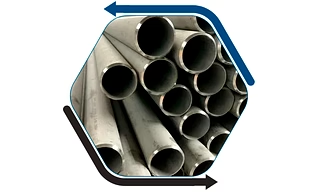
All Steel grades pipe 304/316/202/410/310 etc
Seamless Pipes
How it’s made: Manufactured by piercing a solid billet of steel to form a hollow tube, then extruding or drawing it to size. It has no welded seam.
Key Benefits: Higher pressure ratings, excellent uniformity, and zero risk of weld defects.
Best For: High-pressure, high-temperature, or critical environments (e.g., oil and gas, chemical processing).
Welded Pipes
How it’s made: Formed by rolling a flat strip or plate of steel into a cylinder and welding the seam longitudinally.
Key Benefits: More cost-effective, precise wall thickness, and available in larger diameters.
Best For: Low to medium-pressure applications, architectural structures, and general fluid transport.
2. Key Stainless Steel Grades
Stainless steel is broadly categorized into series based on its crystalline structure and alloying elements.
Austenitic Series (300 & 200 Series) - Most Common
Grade 304: The industry standard ("18/8" stainless). Excellent corrosion resistance and formability. Used in food processing, brewing, and everyday piping.
Grade 316: Contains added Molybdenum (usually 2-3%), which gives it superior resistance to chlorides and pitting. Essential for marine environments, chemical plants, and pharmaceuticals.
Grade 202: A lower-cost alternative where Manganese and Nitrogen replace some of the Nickel. It has decent strength but significantly lower corrosion resistance than 304. Best for indoor decorative or low-exposure use.
Martensitic & Ferritic Series (400 Series)
Grade 410: A basic martensitic grade containing 11.5% Chromium. It is magnetic and can be heat-treated for high hardness and strength, but its corrosion resistance is lower than the 300 series. Used for high-stress parts, valves, and petrochemical applications.
3. High-Nickel & "Percentile" Alloys
When standard stainless steel fails due to extreme heat, severe acids, or immense stress, high-nickel superalloys (often referred to based on their high elemental percentages) are used.
| Alloy Family | Key Characteristics | Typical Applications |
| Hastelloy (e.g., C-276, C-22) | High percentage of Nickel, Molybdenum, and Chromium. Offers unmatched resistance to aggressive chemicals, wet chlorine gas, and strong acids. | Chemical processing, pollution control, acid production. |
| Inconel (e.g., 600, 625, 718) | Nickel-Chromium based. Maintains its high tensile strength and oxidation resistance at extreme temperatures where standard steel would melt or warp. | Aerospace, jet engines, nuclear reactors, gas turbines. |
| Monel (e.g., 400, K-500) | Nickel-Copper alloy. Highly resistant to seawater, hydrofluoric acid, and alkalis. | Marine engineering, piping exposed to brackish water, chemical valves. |
| Duplex / Super Duplex (e.g., 2205, 2507) | A 50/50 mix of Austenitic and Ferritic steel. Delivers double the strength of standard 304/316 and exceptional resistance to stress corrosion cracking. | Desalination plants, offshore oil rigs, subs |
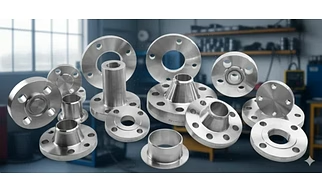
steel Flanges in all grades 304,316,330,410,etc
1. Core Types of Flanges
Different flange configurations are selected based on the pressure, temperature, and mechanical stress of the piping system:
Weld Neck (WN): Features a long tapered hub that is butt-welded to the pipe. Excellent for high-pressure, severe-velocity, or extreme temperature fluctuations.
Slip-On (SO): Slipped over the pipe and welded both inside and outside. Easier to align than WN but offers less mechanical strength under cyclic loading.
Blind (BL): A solid disc used to seal or block off the end of a piping system or vessel. Subject to high mechanical stress from internal pressure.
Socket Weld (SW): The pipe fits into a counterbore and is fillet-welded from the outside. Typically restricted to smaller sizes (up to 2") in high-pressure applications.
Lap Joint (LJ): Used in conjunction with a stub end. The flange slips over the pipe but is not welded; instead, it backs up the stub end. Perfect for systems requiring frequent dismantling and cleaning.
Threaded (TH): Attached to the pipe via matching threads without structural welding. Ideal for low-pressure, ambient-temperature systems or where welding is hazardous.
2. Size and Pressure Frameworks
Flanges are universally manufactured according to specific dimension standards:
Dimensional Standards
ASME/ANSI B16.5: Covers nominal pipe sizes (NPS) from $1/2"$ to $24"$.
ASME B16.47 (Series A & B): Covers large-diameter flanges from $26"$ to $60"$.
EN 1092-1: The European metric equivalent standard.
Pressure Classes (ASME)
Flanges are rated by pressure-temperature limits, categorized into Classes 150, 300, 400, 600, 900, 1500, and 2500. Wall thickness, outer diameter (OD), and bolt circle configurations scale strictly up with higher pressure classes to ensure structural integrity.
3. Material Grades
Stainless Steel (SS) Grades
Stainless steel choice determines the corrosion resistance, temperature threshold, and strength of the flange:
Austenitic Grades (300 Series):
304/304L: The standard 18/8 structural stainless steel. Excellent general corrosion resistance and weldability, but susceptible to chloride-induced pitting.
316/316L: Upgraded with Molybdenum (2–3%). Greatly increases resistance to pitting and crevice corrosion in chloride/marine environments.
330: High Nickel (35%) and Chromium (19%) alloy. Designed for extreme heat resistance, oxidation, and carburization up to 1038°C.
Martensitic Grades (400 Series):
410: A basic, hardenable martensitic stainless steel (11.5% Chromium). Provides high mechanical strength and moderate corrosion resistance, often used for parts needing wear resistance under less aggressive chemical environments.
Advanced / Specialized Grades:
910 / Lean Duplex (e.g., NAS 910 / 10CrMo9-10 equivalents): Depending on the exact standard designation, this represents high-performance materials like lean duplex stainless steels (offering double the yield strength of ordinary austenitic grades and excellent stress corrosion cracking resistance) or specific Cr-Mo pressure vessel alloy steels engineered for severe high-temperature boiler and refinery services.
Hastelloy (Nickel-Base Alloys)
For environments where even high-grade stainless steels fail due to aggressive acid attack, localized pitting, or massive thermal stress:
Hastelloy C276: The industry standard for extreme chemical processing. Highly resistant to strong reducing agents, oxidizing salts, chlorine gas, and formic/acetic acids.
Hastelloy C22: Offers even better overall corrosion resistance than C276 in highly oxidizing environments or mixtures containing nitric acid.
Hastelloy B2/B3: Specifically tailored for handling high concentrations of hydrochloric acid ($\text{HCl}$) across a wide temperature range.
Quick Reference Summary Matrix
| Material Family | Common Grade | Key Performance Attribute | Primary Application |
| Austenitic SS | 304L / 316L | General corrosion resistance, excellent forming/welding | Commercial piping, water treatment, general chemicals |
| High Heat SS | 330 | Oxidation and carburization resistance up to 1038°C | Furnaces, thermal processing, exhaust systems |
| Martensitic SS | 410 | High hardness, high mechanical strength | High-stress mechanical parts, mild chemical service |
| Duplex / Alloy | 910 Class | Exceptional strength, high-yield pressure capabilities | Refineries, oil & gas lines, high-pressure vessels |
| Superalloy | Hastelloy C276 | Outstanding resistance to pitting and severe reducing/oxidizing acids | Chemical plants, offshore gas extraction, flue gas desulfurization |


 GL Trustmark