Kannauj Attar: How It Is Made and Why It Is Special

Quick answer
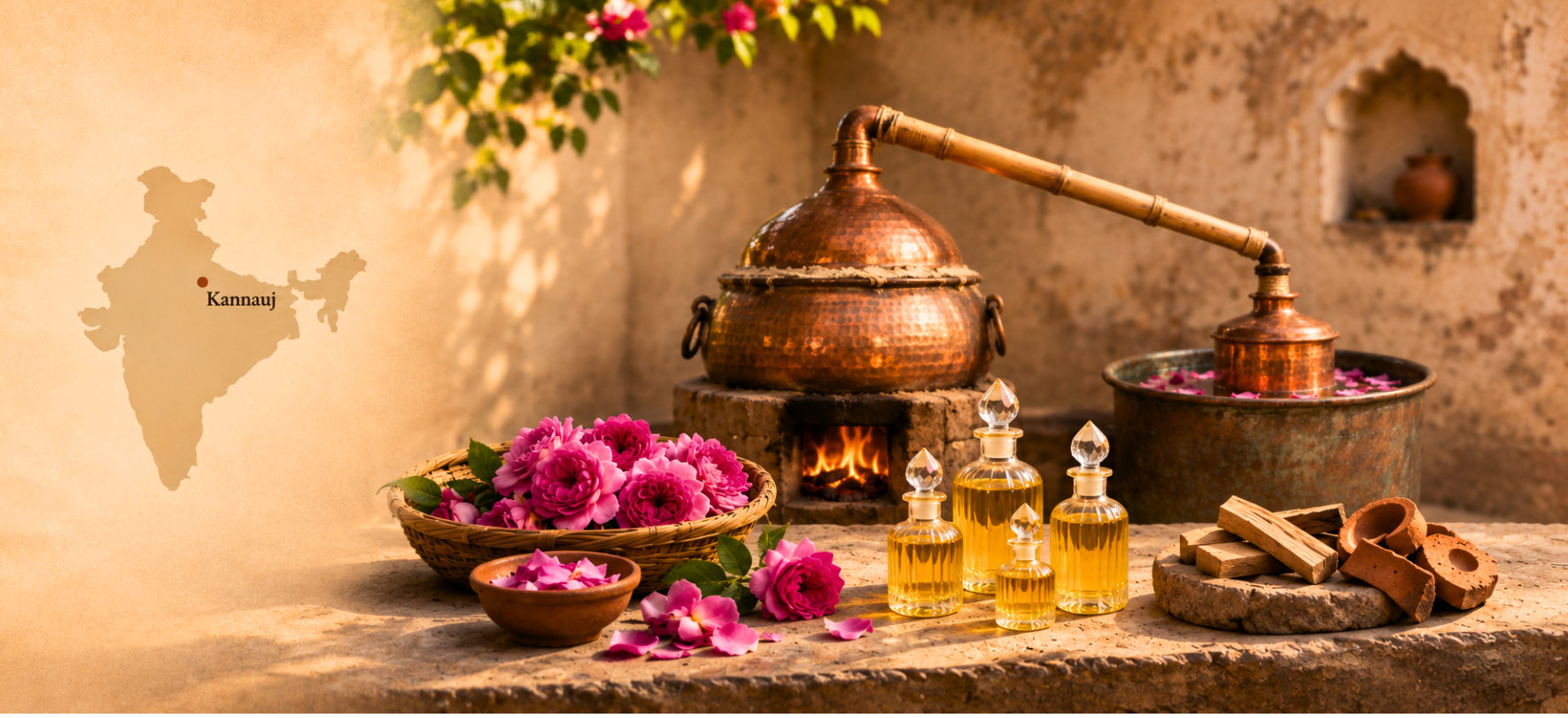
Kannauj attar is attar made in and around Kannauj, a town in Uttar Pradesh known as the perfume capital of India. Makers there capture the scent of flowers, herbs and baked clay in sandalwood oil, using the traditional deg-bhapka method in copper stills. The result is an alcohol-free perfume oil. The long craft, the local materials and the many makers in one place are why buyers look to Kannauj, and why "Kannauj attar" and "Kannauj perfume" are among the most searched attar terms in India.
Kannauj attar at a glance
|
Item |
What to know |
|
Place |
Kannauj, Uttar Pradesh |
|
Base oil |
Sandalwood oil, traditionally |
|
Method |
Deg-bhapka: a copper still, a bamboo pipe and a receiving vessel |
|
Alcohol |
Usually none |
|
Known attars |
Rose, mitti (baked clay), shamama, kewra and sandalwood |
|
Usual pack |
Small bottles of a few ml |
|
Who buys it |
Perfumers, retailers and exporters |
Why Kannauj is the perfume capital of India
Kannauj has made attar for many generations. Growers, distillers, bottle makers and traders sit close together, so a maker can find flowers, copper stills, sandalwood oil and packaging nearby. That cluster is why the Kannauj attar market is so wide, from small family workshops to larger firms that supply exporters.
How Kannauj attar is made
The attar making process follows the same steps in most workshops. Details differ by maker and by scent.
- Gather the material. Flowers, herbs or clay are collected fresh, and flowers are often picked early in the day.
- Load the deg. The material and water go into a copper pot called a deg, which is sealed with clay.
- Heat it. A wood or fuel fire heats the pot, and the vapour rises.
- Carry the vapour. It travels through a bamboo pipe into a second copper vessel called a bhapka.
- Capture the scent. The bhapka holds sandalwood oil, which absorbs the scent. A cool water bath keeps the vapour condensing.
- Repeat. Distillation can run for many hours or days, and batches may be combined.
- Rest. The attar is stored in sealed containers so the scent settles.
- Separate and bottle. Any water is separated, and the attar goes into small glass bottles.
What is the deg-bhapka method?
Deg-bhapka is the traditional way to make attar in Kannauj. The deg is the copper still, the bhapka is the receiver, and a bamboo pipe joins them. Instead of using alcohol, the method uses sandalwood oil to hold the scent. Modern makers may also use other methods, such as blending materials. Ask each supplier which one it uses, because the method affects the scent and the price.
Famous Kannauj attars
- Mitti attar: the scent of rain on dry earth, made by distilling baked clay into sandalwood oil. Kannauj mitti attar is one of the best known attars in India.
- Shamama attar: a warm, rich blend of herbs, spices and flowers that is usually aged. It is a favourite with buyers who like deep scents.
- Rose attar: a soft floral scent from rose petals.
- Sandalwood attar: a creamy, woody scent, and also the base for many other attars.
- Kewra attar: a sweet floral scent from the pandanus flower.
Why Kannauj attar is special
- It is alcohol-free in most traditional forms, which suits buyers who avoid alcohol.
- It uses a natural base oil instead of alcohol, so the scent sits close to the skin.
- It is slow, small-batch work, with knowledge handed down across generations.
- It offers range: florals, woods, earth and blends from one town.
- It is easy to buy in bulk, because many makers sell to perfumers, retailers and exporters.
Kannauj attar price: what affects it
Prices vary a lot. Rose and oud cost more because the materials cost more. The amount of sandalwood oil, the number of batches, the ageing time and the pack size all change the price. When you compare, ask what the attar is made from, which base oil it uses, whether it is pure or blended, and the price per ml. "Pure attar" is not a regulated term, so ask what it means for that maker.
How to choose a Kannauj attar maker
- Which materials and which base oil does it use?
- Does it use the deg-bhapka method, or another one?
- Can I get samples, and what do they cost?
- What are the pack sizes and the minimum order?
- Which documents does it hold (COA, MSDS, and IFRA where needed)?
- Does it offer private label, and who owns the scent?
- Does it export, and how does it pack glass for transport?
Find Kannauj attar suppliers on GlobalLinker
On GlobalLinker you can compare Kannauj attar manufacturers and wholesale suppliers and send an enquiry to several of them. If you plan your own brand, see private label perfume manufacturers in India and perfume bottle wholesale and packaging for attar bottles. To compare attar with spray perfume, read attar vs perfume: what is the difference.
FAQ
1. Why is Kannauj called the perfume capital of India?
Kannauj has made attar for many generations, and growers, distillers, bottle makers and traders sit close together in and around the town. That cluster gives buyers many makers and many scents in one place, which is why Kannauj is called the perfume capital of India.
2. How is Kannauj attar made?
Makers heat flowers, herbs or clay in a copper pot called a deg. The vapour passes through a bamboo pipe into a vessel of sandalwood oil, which absorbs the scent. The process can run for many hours or days, and then the attar rests before bottling.
3. What is the deg-bhapka method?
Deg-bhapka is the traditional way to make attar in Kannauj. The deg is the copper still, the bhapka is the receiving vessel, and a bamboo pipe joins them. Sandalwood oil in the bhapka holds the scent, so no alcohol is needed.
4. What is mitti attar, and why is it linked to Kannauj?
Mitti attar captures the scent of rain on dry earth. Makers distil baked clay into sandalwood oil. Kannauj makers are known for it, and Kannauj mitti attar is one of the best known attars in India. Ask each maker how it makes its version.
5. What is shamama attar?
Shamama attar is a warm, rich blend of herbs, spices and flowers, and it is usually aged. Each maker has its own recipe, so two shamama attars can smell very different. Ask for samples from more than one Kannauj maker before you order.
6. How much does Kannauj attar cost?
Prices vary a lot. Rose and oud cost more because the materials cost more, and the base oil, the number of batches, the ageing and the pack size also change the price. Ask each maker for the price per ml, and compare quality, not bottle size alone.
7. Is Kannauj attar alcohol-free?
Most traditional Kannauj attars are oil-based and contain no alcohol, because sandalwood oil carries the scent. Some modern products mix attar with other ingredients, so read the label or ask the maker to confirm the base oil and ingredients in writing.
8. How can I buy Kannauj attar in bulk?
Compare Kannauj attar makers by materials, base oil, pack sizes, minimum order and documents, then ask for samples. On GlobalLinker you can send one enquiry to several Kannauj attar manufacturers and compare their quotes before you order.
Image source: Open AI
Disclaimer: The views and opinions expressed in this article are those of the author and do not necessarily reflect the views, official policy or position of GlobalLinker.
My endeavour is to help business owners digitise, network and grow easily. Towards this I help organise webinars, curate articles and answer queries via our help centre.