How can self-help groups sell online? A guide for the institutions that support them
|
The short answer Self-help groups can sell online when a supporting institution provides three things: an online store for each group, help with payments and delivery, and a shared marketplace where buyers can find them. Because many groups have limited digital experience, the institution should handle technical setup and product listing, then train members on orders. |
India has a very large base of self-help groups. In a written reply in the Lok Sabha on 25 March 2025, the Ministry of Rural Development stated that 10.05 crore rural households had been mobilised into 90.90 lakh SHGs under the Deendayal Antyodaya Yojana – National Rural Livelihoods Mission (DAY-NRLM), a cumulative figure. In Odisha alone, the state's Mission Shakti department says that nearly 70 lakh women are organised into about 6 lakh groups.
Making a product and selling it online are different tasks. An analysis by the Sattva Knowledge Institute, published in India Development Review in January 2023, named four barriers for artisans selling online: limited digital literacy and entrepreneurial skills, high onboarding costs on e-commerce platforms, a few large platforms setting unfavourable terms such as long payment cycles and high commissions, and limited logistics options. That analysis covered artisans and handloom weavers, not SHGs as such, but the barriers apply to SHG producers too. They are also the reason an institution usually has to lead.
This guide covers what already exists, four ways an institution can help groups sell online, what each group needs, and a worked example from Odisha. A note on the example: I lead digital commerce at GlobalLinker, and GlobalLinker provided the technology in it.
What already exists
Government programmes are already putting SHG products online. The Saras Collection was launched on the Government e-Marketplace (GeM) in May 2020 by the Ministry of Rural Development, with DAY-NRLM, to promote products made by SHGs. At launch, 913 SHGs from 11 states had registered as sellers and 442 products had been onboarded, in five categories: handicrafts, handloom and textiles, office accessories, grocery and pantry, and personal care and hygiene. More recently, the Department for Promotion of Industry and Internal Trade launched DigiHaat, a buyer-side app on the ONDC network (the Open Network for Digital Commerce) for rural and underserved sellers, with a focus on women entrepreneurs and SHG-linked producers. It was announced in March 2026 with a target of nearly 10 crore small producers; no seller totals had been reported.
These are options for an institution to use, not competitors. The question is which combination suits your groups.
Four ways an institution can help groups sell online
|
Route |
Works when |
Watch for |
|---|---|---|
|
1. List on government platforms |
The groups' products fit a programme's categories and you want national visibility with little to build. |
Each group's brand is one among many, and you follow the programme's onboarding rules. |
|
2. List on general marketplaces |
Groups have products with steady supply and want to reach buyers who already shop online. |
Commissions, long payment cycles and logistics terms set by the platform, the barriers noted earlier. |
|
3. Give each group its own store |
Each group has a distinct product and story, and you want groups to build their own customers. |
The group has to bring buyers to the store, and someone has to keep the catalogue current. |
|
4. Give each group a store, plus a shared marketplace |
You want groups to keep their identity while buyers browse across all of them in one place. |
The most complete model and the most to maintain. The shared marketplace needs a sponsor who promotes it. |
The routes combine well: a group with its own store can also be listed on a government platform or a general marketplace, provided one catalogue is kept consistent.
What each group needs to sell
Whatever the route, five things have to be in place for a group to sell: a store or listing, product content (clear photographs and honest descriptions), a way to be paid, a way to deliver, and someone to handle orders. On GlobalLinker's Linker Store, for example, a store can take bulk or single product uploads, enable cash on delivery with OTP verification, use payment gateways such as Razorpay, Easebuzz, EazyPay and PayPal, connect couriers such as Shiprocket and Vamaship, and manage orders, returns and cancellations. The harder part is usually the first: getting good product content in place for groups with little digital experience, and keeping it up to date.
Worked example: Women's SHG stores in Odisha
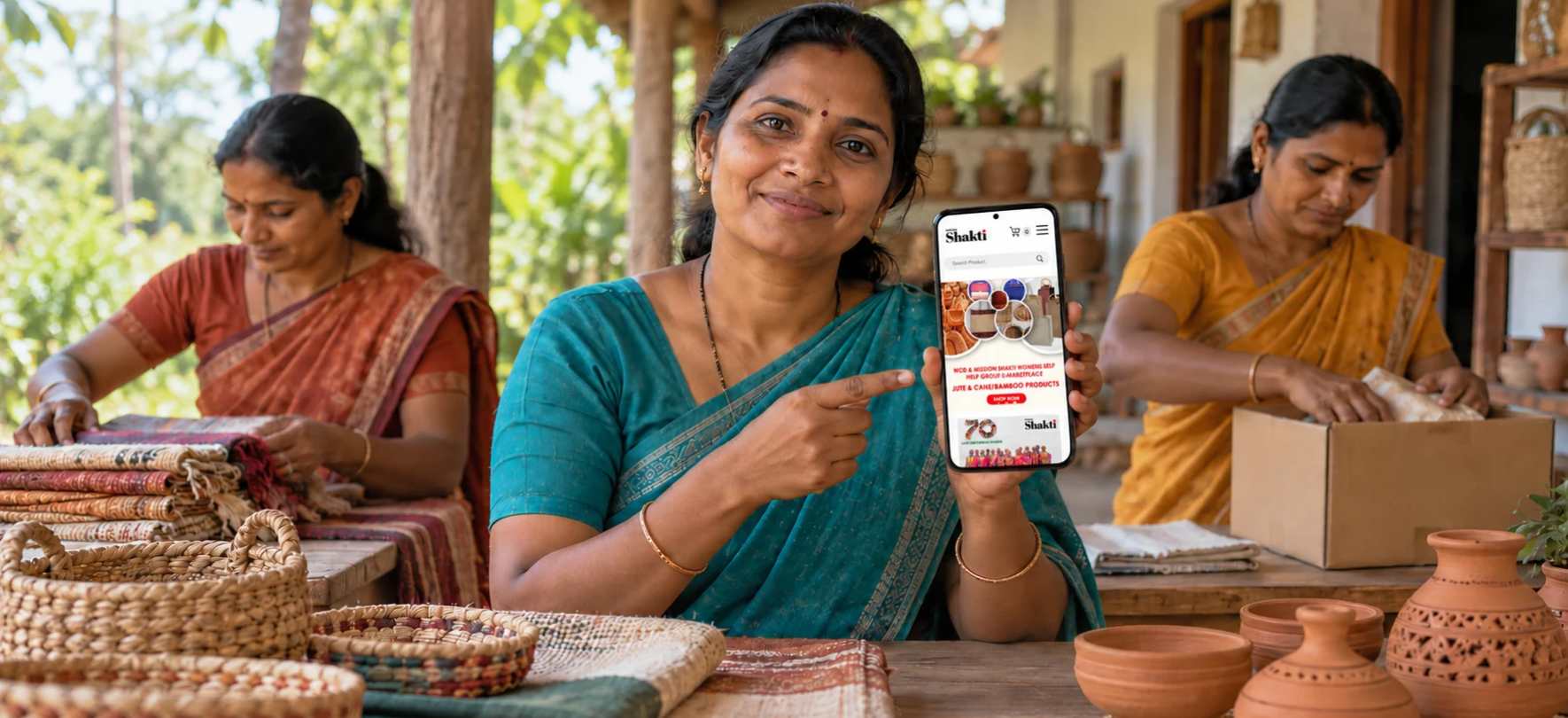
In 2020, GlobalLinker worked with the Odisha government on an initiative to give women's self-help groups their own online stores. The work included seminars and in-person meetings, the creation of independent stores for many groups, product listing and payment activation. Each store was designed to also appear on a shared Mission Shakti eMarketplace, to be jointly marketed and sponsored by the state government, with groups free to promote themselves independently if they had the budget. Mission Shakti is Odisha's state mission for women's self-help groups, which it describes as launched on 8 March 2001.
The stores created in 2020 remain live, with products listed and payment set up. The shared marketplace has not yet been launched. The example shows that groups new to digital tools can be given a working store with products and payments, and it shows the design in practice: each group keeps an independent identity, with a shared marketplace planned as the next step. One of the stores, Sri Jagannath SHG in Nuapada, lists rice varieties such as Swarna and Godavari under groceries and staples.
The stores created in the initiative are listed below.
A checklist for the supporting institution
-
Products. Who are the groups, what do they make, and is quality and supply steady enough to sell?
-
Content. Who will photograph and describe the products, and who will check them?
-
Orders. Who receives orders, who packs them and who answers customer questions, in which language?
-
Money. How will payments reach the group, and into whose account?
-
Delivery. Who delivers, to which areas, and what happens with returns?
-
Promotion. Who promotes the store or marketplace, with what budget, and for how long?
-
Continuity. How long will the institution support the groups, and what happens after?
-
Ownership. Who owns the stores and the customer data?
Cost and timelines depend on the route and the requirement: how many groups, how much managed setup they need, and which integrations you want. Ask any technology partner to explain what drives their figures for your case.
Frequently asked questions
Can a self-help group sell online without its own website?
Yes. A group can list products on a government platform such as the Saras Collection on GeM or on a general marketplace. The trade-off is that the group's brand is one among many and the platform sets the terms.
What do SHGs need in place before they sell online?
Requirements such as bank accounts and registrations depend on the group and the products. Check with your bank or a qualified adviser before you start, and settle who receives the money.
How do SHGs receive payments from online orders?
Through online payment gateways or cash on delivery, depending on the store. The institution and the group need to agree in advance which account receives the money and how quickly it is passed on.
Can many SHGs share one marketplace but keep their own stores?
Yes. That was the design in Odisha: each women's SHG had its own independent online store, intended also to be listed on a shared marketplace.
What can a bank or federation do to help?
Mobilise groups, help them choose a route, fund or sponsor the setup, and take responsibility for promotion and support after launch.
How much does it cost to help SHGs sell online?
It varies by route and requirement: the number of groups, how much managed setup they need, and the integrations you want.
|
Next step Supporting self-help groups and thinking about a store or marketplace? Book a callback or send us an inquiry. |
Sources
Lok Sabha Unstarred Question No. 3982, answered 25 March 2025 (Ministry of Rural Development)
Mission Shakti, Government of Odisha: about the department
Saras Collection launched on GeM (IBEF, from the Government release, 5 May 2020)
ONDC's DigiHaat brings artisans, farmers onto digital commerce grid (IANS, 27 March 2026)
Contributing to the business growth of SME businesses globally by helping them properly utilize our affordable and easy to use digital commerce solutions.