How can a state government build a marketplace for its local sellers?

|
The short answer A state government can build a marketplace for local sellers in four moves: choose whether it is a discovery showcase or a full transaction marketplace, give every seller a profile and catalogue, list their products under one state-branded marketplace, and promote it to buyers. A technology partner can run the platform while the department leads seller onboarding. |
State governments have three realistic ways to put local sellers online, and recent examples show all three. Odisha launched a State e-Pavilion on MSME Global Mart in September 2026. Kerala worked with Flipkart Samarth in February 2026 to bring artisans onto a large private marketplace. Telangana built a state-branded marketplace, Made in Telangana, with GlobalLinker. The question for a department is rarely whether to go online. It is which route, in what order, and who does what.
This guide sets out the routes, then walks through the decisions in the order we have found most useful. A note on the examples: I lead digital commerce at GlobalLinker, and Telangana is a GlobalLinker project, so I have kept the comparison of routes to what each programme has published about itself.
Three routes to a state marketplace
|
Route |
Example |
What it gives you |
What to watch |
|---|---|---|---|
|
List sellers on national channels |
Saras Collection on GeM, launched 4 May 2020 by the Ministry of Rural Development with GeM and DAY-NRLM for self-help group products; its first phase had about 913 SHGs and 442 products from 11 states. ONDC DigiHaat, launched by DPIIT and announced in March 2026, a buyer-side app for rural and underserved sellers, with a target of nearly 10 crore small producers. Odisha State e-Pavilion on MSME Global Mart, launched in September 2026 with NSIC, a showcase for ODOP items, GI-tagged products and artisan clusters. |
National visibility with little to build. |
Your state brand shares space with others, and you depend on a national programme's priorities. |
|
Partner with a private marketplace |
Kerala and Flipkart Samarth, February 2026: about 100 artisans in Aranmula Kannadi, Nettor Craft and Mural Arts onboarded as a government-supported emporium on Flipkart, with training on cataloguing, compliance, logistics and storefront management. |
An existing buyer base and a tested checkout. |
The platform sets the commercial terms, and sellers must work inside them. |
|
Build a state-branded marketplace with a technology partner |
Telangana: Telangana State GlobalLinker (2020) and Made in Telangana, described below. |
Your brand, your seller registry and your own promotion. |
You have to bring buyers: promotion needs an owner and a budget. |
The routes are not exclusive. A state can list sellers on a national channel and run its own marketplace, as long as one seller catalogue feeds both.
Five decisions, in order
1. Choose the marketplace model
A discovery marketplace showcases products and sends the customer's checkout or inquiry directly to the seller. It is the lighter model: the state provides visibility and sellers keep the sale. A full transaction marketplace takes the checkout on the marketplace itself, and can also show products by how close they are to the buyer. It gives the state more control over the buyer experience and more to run. Neither is better in general. The choice depends on whether the goal is visibility for sellers or a managed buying experience, and on how much operating responsibility the department wants to carry.
2. Start with sellers, not the storefront
A marketplace with few products does not attract buyers. Telangana built the seller layer first. Telangana State GlobalLinker, launched in 2020, is a digital ecosystem where businesses from the state register, create a profile, list products and either build a website themselves or have the GlobalLinker team build one. As of October 2026, about 3,500 businesses had joined, according to GlobalLinker's own data.
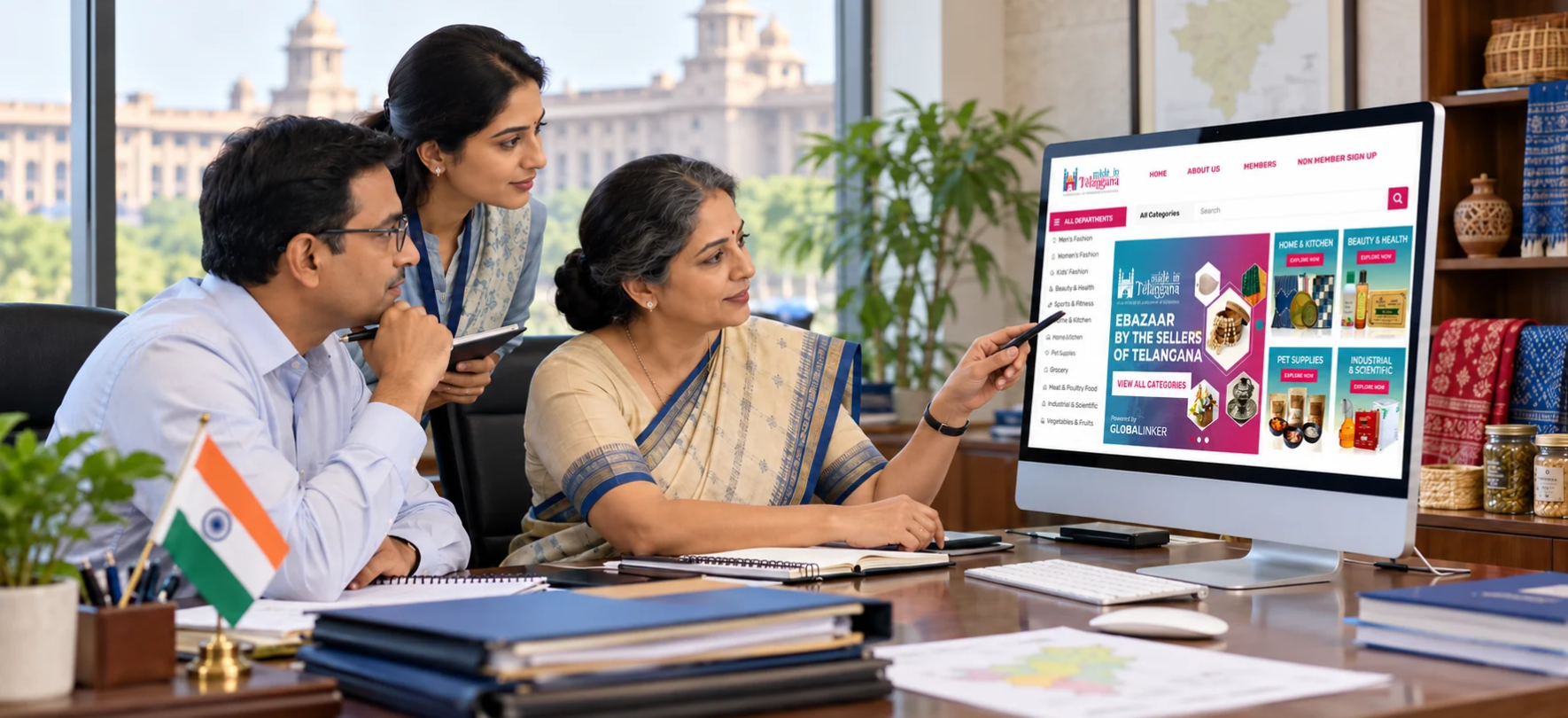
Made in Telangana came next. The products of the sellers who join Telangana State GlobalLinker are showcased there. Its page describes it as an initiative of the Government of Telangana in partnership with GlobalLinker, with the aim of bringing all sellers of Telangana onto a common online platform. It was created to give the state's businesses added visibility with domestic and international buyers. Both Made in Telangana and the co-branded solution are live.
3. Decide who runs what
|
The department |
The technology partner | |
|---|---|---|
|
Purpose |
Sets the objective and the seller eligibility rules. |
Delivers the platform that meets them. |
|
Sellers |
Mobilises sellers and owns the relationship. |
Provides onboarding tools and, where needed, managed setup of profiles, catalogues and websites. |
|
Platform |
Approves the brand, policies and terms. |
Builds, hosts and maintains the platform and its seller tools. |
|
Promotion |
Names an owner and funds it. |
Supports with content and tools. |
|
Continuity |
Commits sponsorship beyond launch. |
Supports sellers and the department over time. |
One way to formalise this is a co-branded solution: the technology partner builds a platform under the government body's own brand, and the body uses it to onboard its members. GlobalLinker offers co-branded solutions of this kind to governments, trade bodies, associations and large organisations. Telangana State GlobalLinker is an example.
4. Plan payments, delivery and seller policies
Each seller store needs a way to be paid, a way to deliver, and clear policies. That usually means cash on delivery where appropriate, one or more online payment gateways, courier integration, and published shipping and returns policies. For example, on GlobalLinker's Linker Store sellers can use gateways such as Razorpay, Easebuzz, EazyPay and PayPal, switch on cash on delivery with OTP verification, and activate couriers such as Shiprocket and Vamaship. Whatever platform you choose, check these basics before launch, because a first order that cannot be paid for or delivered costs more than the effort to fix it.
5. Name a promotion owner and plan for continuity
A marketplace that nobody promotes is a catalogue. Name one person or team in the department who owns promotion to buyers, give it a budget line, and decide how long the sponsorship will run. Marketplaces need time to build buyers and repeat customers, so a plan that depends on a single launch event is a risk. Telangana's marketplace was designed so that its sellers can be promoted to domestic and international buyers; the plan for promotion matters as much as the platform.
Mistakes to avoid
-
Launching the storefront before the sellers. Buyers who find few products do not come back.
-
No named promotion owner. Without one, promotion becomes everyone's job and so no one's.
-
Assuming sellers will manage listings alone. Many small sellers need help with photographs, descriptions and prices. Plan managed setup for those who need it.
-
Leaving data ownership and exit terms unwritten. Agree in writing who owns seller and buyer data, and what the partner hands over if the arrangement ends.
-
Treating launch as the finish. The first months show what sellers and buyers actually need.
Before you choose a technology partner
Compare partners on the same questions, in writing, and ask to see live examples. View our checklist of questions to ask a technology partner. Cost and timelines vary by model and requirement, so ask each partner what drives their figures for your case.
Frequently asked questions
What is a state government online marketplace?
It is a digital platform, run by or for a state government, where the state's local sellers list products for buyers within and beyond the state. It can be a discovery marketplace, where checkout goes to the seller, or a full marketplace with checkout on the platform.
Should a state build its own marketplace or use national platforms?
It does not have to choose. National channels such as Saras on GeM, ONDC DigiHaat and MSME Global Mart state e-pavilions give national visibility with little to build, while a state-branded marketplace gives control of brand, seller registry and promotion. Many states can use both from one seller catalogue.
Who should run it: the department or a technology partner?
Usually both. The department sets objectives, mobilises sellers, approves policies and owns promotion. The technology partner builds and maintains the platform and supports sellers.
How many sellers does a state marketplace need to launch?
There is no fixed number. Start with a pilot group large enough to show a real range of products, then add sellers in stages.
How long does it take and what does it cost?
Both vary by model and requirement: discovery or full marketplace, the number of sellers, how much managed setup they need, and which integrations are required. Ask partners to explain what drives each figure.
Who owns the seller data?
Agree this in writing before you begin: who owns seller and buyer data, who can access it, and what the technology partner must hand over if the arrangement ends.
|
Next step Planning a marketplace for your state's sellers? Book a call or send us an enquiry. |
Sources
Saras Collection launched on the Government e-Marketplace (GKToday)
ONDC's DigiHaat brings artisans, farmers onto digital commerce grid (IANS, 27 March 2026)
Odisha launches State e-Pavilion on MSME Global Mart (Construction World, 9 September 2026)
Flipkart Samarth in Kerala (Flipkart Stories, 5 February 2026)
Image source: Open AI
Disclaimer: The views and opinions expressed in this article are those of the author and do not necessarily reflect the views, official policy or position of GlobalLinker.
Contributing to the business growth of SME businesses globally by helping them properly utilize our affordable and easy to use digital commerce solutions.