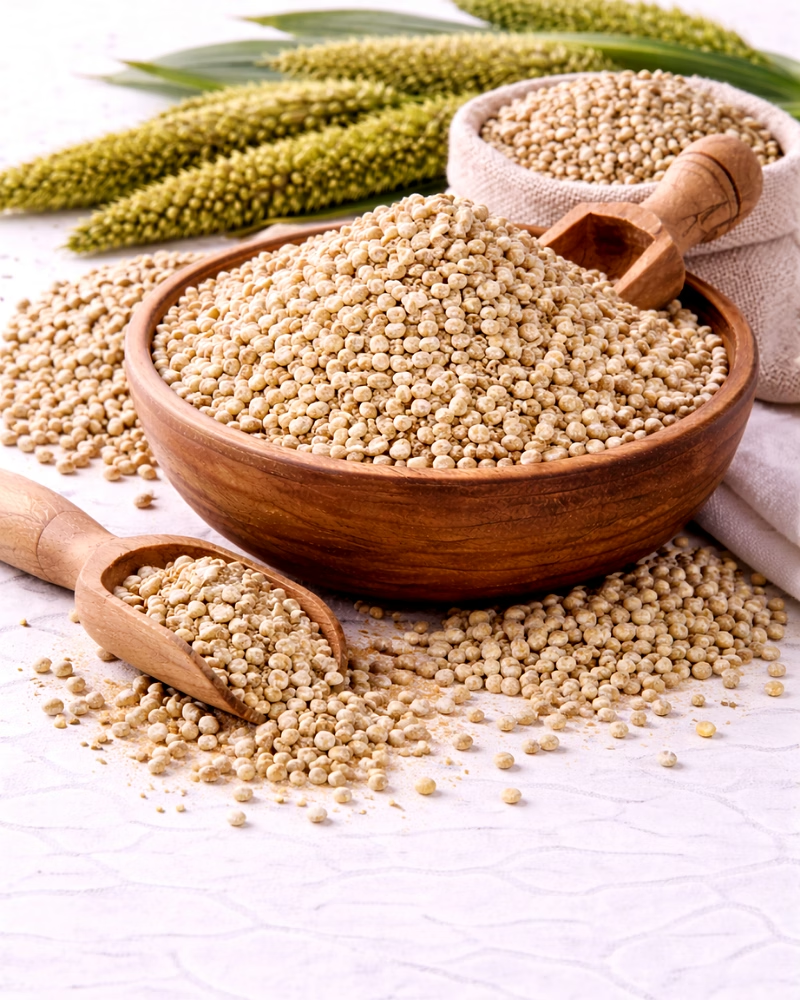
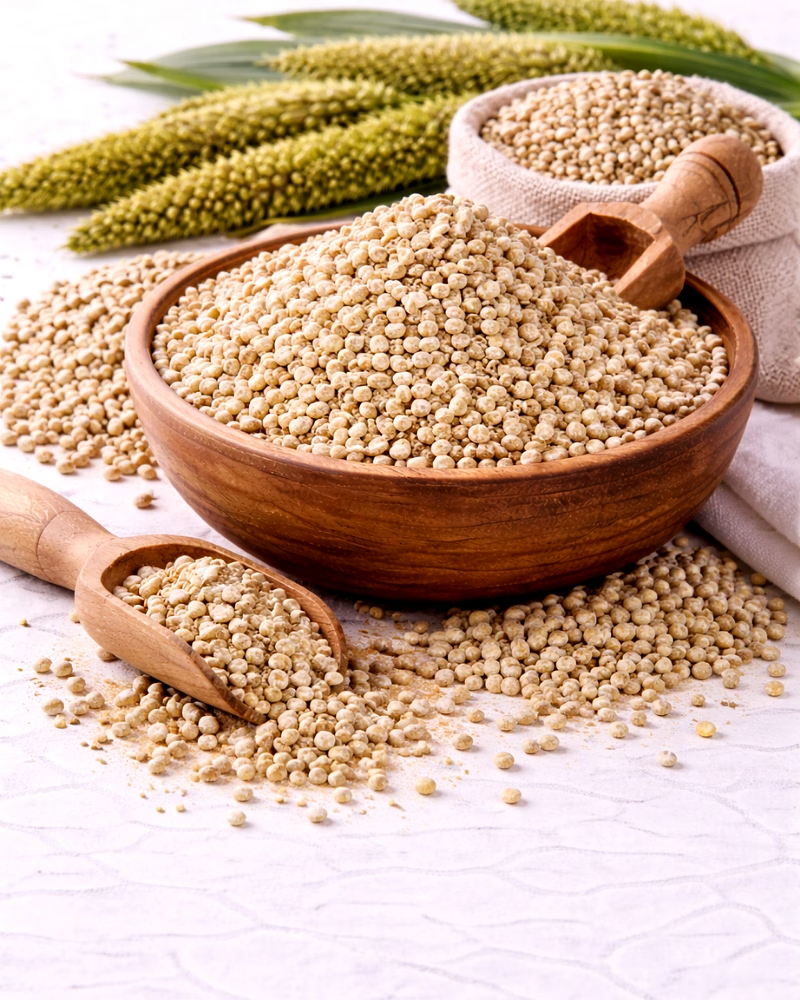
pearl millet supplier – Whole Pearl Millet for Flour and Food Production
pearl millet supplier provides whole pearl millet grain lots graded for milling into flour, cereal porridge manufacture, and animal-feed blending. Typical buyers are flour mill operators, cereal manufacturers and feed formulators seeking consistent kernel hardness and predictable extraction yield. The core buyer pain point is variable kernel hardness and moisture that affect energy consumption and flour color.
Product is supplied in large-volume formats with lot-linked COA showing moisture and basic physical metrics. Packaging aligns with bulk handling systems; private-label packaging is available when pack-size and monthly-volume requirements are specified.
Key Features
- Uniform grain selection reduces variability in mill throughput and helps stabilize product color and particle distribution.
- Moisture-controlled lots decrease the frequency of mill clogging and reduce energy spikes during grinding.
- Reduced foreign matter lowers pre-cleaning time and improves safety for direct-food processing lines.
Technical Attributes
- Moisture: typically 10–13% (indicative) — target band for milling and storage.
- Kernel hardness: reported per lot (useful to set mill gap and roller pressures).
- Foreign matter: commonly <1.0% (indicative) — affects pre-cleaning workload.
- Test weight: provided on COA to help predict flour yield.
Material Composition and Physical Properties
Pearl millet grain is a hard kernel with a hull and starchy endosperm. Kernel hardness and moisture determine energy input during milling and the resulting granulation profile. Varietal choice influences flour color and protein content, which matter for bakery and porridge applications.
Quality control includes cleaning, sizing, and moisture stabilization. Traceability links each lot to harvest season and basic physical metrics reported on the COA.
Functional Performance & Operational Efficiency
For flour production, consistent kernel hardness minimizes roller and sieve wear and stabilizes particle-size distribution, which directly impacts baking performance and hydration rates. For porridge or cereal use, final color and solubility depend on cultivar and milling fraction selection.
Processing Insight
Kernel moisture above the recommended band increases breakage in pneumatic conveyors and raises mill energy use. Pre-conditioning (tempering) can be applied to reduce dust during grinding and influence starch release; tempering parameters should be validated at pilot scale.
Applications & Industry Deployment
- Millet flour production for bakery manufacturers — Buyer context: consistent particle-size and color; Technical need: stable kernel hardness; Outcome: predictable bake performance and color.
- Porridge and cereal manufacture — Buyer context: instant or slow-cook products; Technical need: controlled solubility and gelatinization behavior; Outcome: repeatable mouthfeel and cook-time.
- Animal feed blending — Buyer context: bulk blending with other grains; Technical need: predictable bulk density; Outcome: consistent blend ratios.
Procurement & Packaging Guidance
Request lot COA focused on moisture and test weight before scale-up. Packaging is arranged to support pallet-handling and hopper feed systems. Provide intended end-use and monthly volumes to define packaging and delivery cadence.
Frequently Asked Questions
- What is your minimum order quantity for bulk Pearl Millet shipments? MOQ is set by pack format and shipment mode; exact MOQ is provided after intended pack-size and destination are specified.
- Do you offer volume pricing for wholesale Pearl Millet orders? Volume pricing is tiered and depends on committed monthly volumes and selected grain specification; share expected volumes to receive an indicative structure.
- What moisture content is recommended for Pearl Millet to ensure shelf stability? Recommended moisture is typically 10–13% (indicative); this band reduces breakage and supports storage stability. Confirm target via lot COA for long transit times.
- What is the typical shelf life of Pearl Millet under proper storage? Stored dry and cool with moisture control, pearl millet commonly remains stable for 9–12 months; verify against COA and storage environment.
- Which compliance documents are included per lot? Lot-specific COA and select business-level registration documents can be provided during procurement review.
Description provided by Shivay Export.
Light grey to yellowish or brown
Thrives in hot climates and poor soil conditions
Staple food in Asia and Africa
Long-lasting when stored properly
1 unit (flexible for bulk orders)
Specifications
Species
Pennisetum glaucum
Texture
Small, round grains
Color Range
Light grey, yellowish, brown
Climate Suitability
Highly resilient to dry, hot climates
Soil Adaptability
Grows well in poor soil
Common Regions
Asia, Africa
Use Case
Food processing, animal feed, direct consumption