Material Composition and Physical Properties
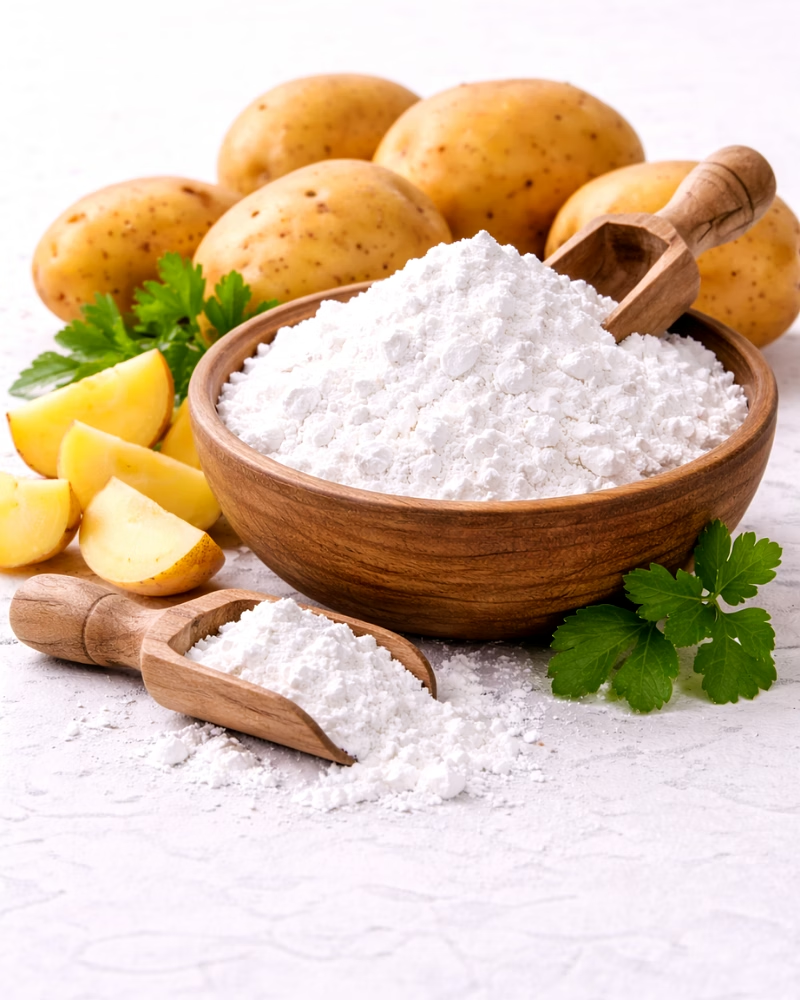
Composition: native potato starch powder composed predominantly of starch granules isolated from tuber tissue. The powder is dry, free-flowing and formulated to a controlled moisture band to support industrial dosing systems. Granule morphology contributes to rapid swelling during gelatinization and produces a glossy, viscous matrix in heated sauces. Quality controls focus on starch assay, moisture measurement and foreign-matter limits to maintain consistent functional performance.
Technical Specifications and Key Parameter
Functional performance is driven by starch concentration, particle dispersion and gelatinization temperature. In practice, sauces reach target viscosity when potato starch is hydrated in warm water and heated into its gelatinization window (indicative 58–68°C). Typical usage ranges from 0.5–5.0% w/w; lower levels provide light thickening and sheen, higher levels increase yield and body. For continuous cookers, pre-slurry dispersion and staged heating reduce lump formation.
Processing Insight / Technical Insight
Native potato starch delivers a high peak viscosity but can show retrogradation and syneresis under repeated freeze–thaw cycles or prolonged refrigerated storage. For formulations subject to freeze–thaw cycling or long refrigerated hold times, consider modified grades; otherwise native starch offers superior viscosity per weight for hot-fill sauces. Mechanical shear during high-speed mixing can temporarily reduce peak viscosity; allow a short rest post-mixing to restore structure before final filling.
Functional Performance & Operational Efficiency
In applied use the powder provides rapid viscosity build once gelatinized and contributes to mouthfeel with low particulate perception. It performs well in kettle or in-line cooker systems when dispersed as a cold slurry or dry-blended with other dry ingredients. Its controlled moisture minimizes dosing variance in volumetric feeders and reduces downtime from hopper bridging. Stability under pH ranges commonly encountered in savory sauces (mildly acidic to neutral) is adequate; extreme acidity will alter gel strength and should be verified in lab trials.
Applications and Use Cases
- Sauce manufacturing for pasta product manufacturers — Buyer context: continuous cooker lines needing consistent viscosity setpoint. Technical requirement: predictable peak viscosity and sheen at 1–3% inclusion. Outcome: uniform fill weights, consistent mouthfeel across lots.
- Soup base for instant soup producers — Buyer context: dry-mix blending and reconstitution performance. Technical requirement: rapid dispersion and heat-activated thickening. Outcome: stable suspension of particulate inclusions and controlled mouth-coating on rehydration.
- Seasoning blends for snack food manufacturers — Buyer context: adhesive binder for dry seasoning application. Technical requirement: tack development at low hydration levels. Outcome: improved seasoning adhesion and reduced dust-off during packaging.
Bulk Supply, Packaging, and Export Logistics
Packaging formats are offered in multi-layer sacks and poly-lined bags suitable for palletized transport and mechanized unloading. Large-volume shipments can be arranged with lot-linked documentation; packaging options and labeling configurations can be aligned to private-label requirements. Lead times and export documentation are handled per shipment request and are quoted against specified volume and destination.
Quality Standards and Compliance Documentation
Quality control focuses on starch assay, moisture, foreign matter, microbial screening and particle-size checks. Batch certificates and test reports can be issued with each lot to support incoming QC and regulatory review.
Procurement note
Share required grade, target application and monthly volumes to receive a fit-for-purpose specification sheet and lot COA for evaluation.
Frequently Asked Questions
- What is your minimum order quantity for bulk potato starch shipments? Typical minimums are set by pack and shipment method; provide target monthly volume and preferred pack format so a shipment configuration and MOQ can be proposed.
- Do you offer volume pricing for wholesale potato starch orders? Volume-based pricing is available and depends on annual commitment, pack format and delivery schedule; submit projected volumes and packing requirements to receive a tiered quote.
- What viscosity performance should I expect from potato starch in sauce formulations? Expect strong peak viscosity after gelatinization; at 1–3% inclusion most sauces achieve paste-like body. Exact cP or RVA values vary with solids, pH and heating profile, so run pilot trials for target set points.
- What is the typical shelf life of potato starch under proper storage? When stored dry in a sealed container away from high humidity and direct heat, typical shelf stability is 12–18 months; monitor moisture and microbial indicators per lot COA.
- Which certifications or compliance documents can be supplied with shipments? Lot-specific certificates and test reports are available. Company registrations and product certificates provided on request include statutory and food-safety paperwork as applicable; request the specific documents needed for import clearance or regulatory review.
Description provided by Shivay Export.
High Viscosity for Thickening
High Clarity in Food Applications
Food Industry, Textile, Paper, Pharmaceutical
Thickening, Binding, Stabilizing Agent
Typically 12 Months (Stored in Dry Conditions)