Private Label vs Third-Party vs Contract Manufacturing for Cosmetics

Quick answer
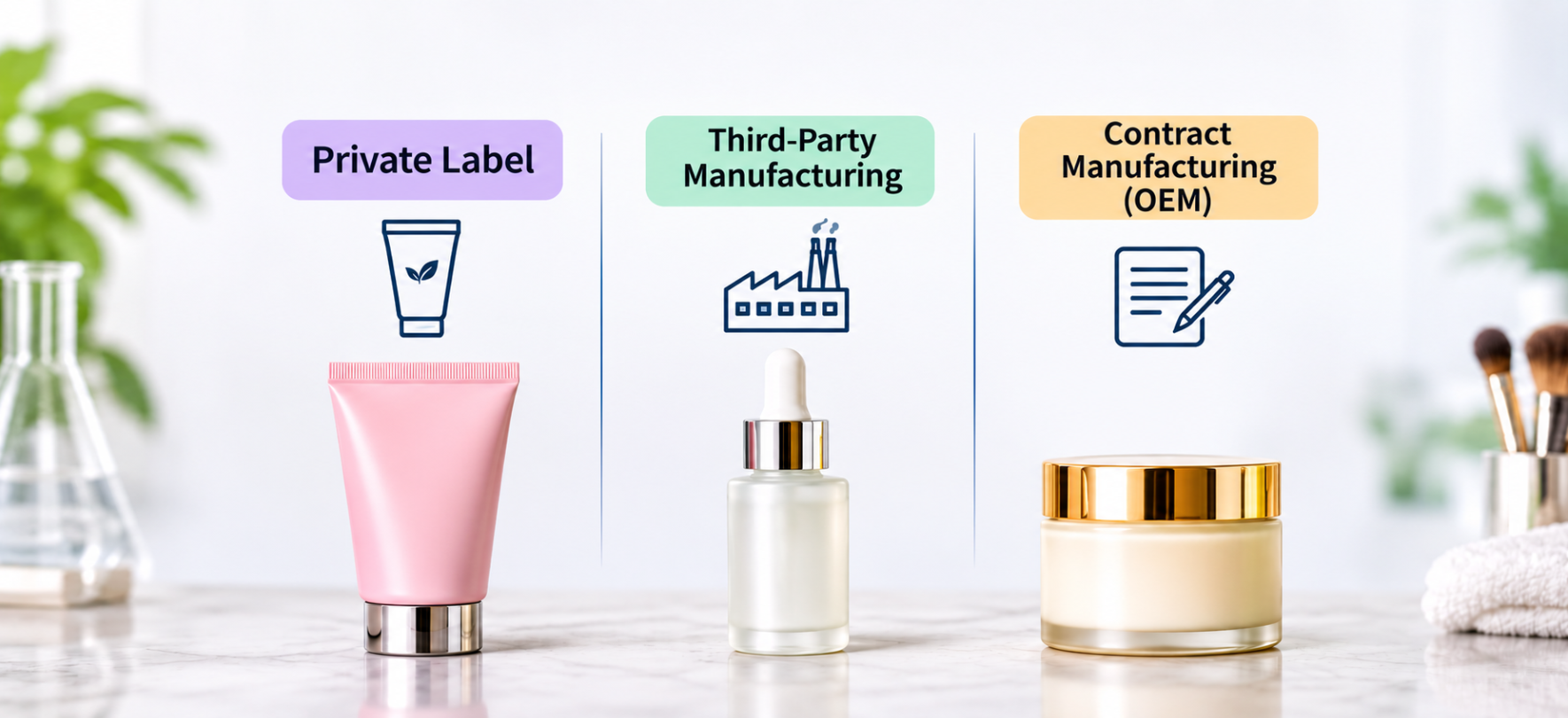
Private label cosmetics are products that a manufacturer makes, often from its own base formula, and that you sell under your brand. Third-party manufacturing means another company's factory makes your product for you, using its formula or yours. Cosmetic contract manufacturing is the same idea with a written agreement on the specification, the quantity and the price. In India the three terms overlap, so always ask a manufacturer exactly what its offer includes: the formula, the packaging, the minimum order and who owns what.
Private label, third-party and contract manufacturing at a glance
Here is contract manufacturing vs private label, with white label and ODM beside them.
|
Model |
Who creates the formula |
Is it exclusive to you? |
How much you can change |
Best for |
|
White label |
The manufacturer, from its existing range |
No, other brands may sell the same product |
The label, and sometimes the packaging |
A fast launch with a small first order |
|
Private label |
The manufacturer, adjusted to your brief |
Usually yes for your version, if agreed in writing |
Blend, ingredients within limits, and packaging |
A distinct product without your own chemist |
|
Third-party manufacturing |
The manufacturer's formula or yours, by agreement |
Depends on the agreement |
Depends on the agreement |
Brands that have no factory |
|
Contract manufacturing (OEM) |
You or your chemist: your own formula or a detailed specification |
Yes, it is your formula |
Almost everything |
Brands that already have a formula |
|
ODM |
The manufacturer designs it |
Depends on the contract |
You choose from its designs and add your brand |
Brands that want design help |
What is private label cosmetics?
Private label cosmetics are made for your brand. You give the manufacturer a brief, such as the product type, the skin or hair need, the scent and the packaging, and the manufacturer adjusts a base formula or builds one for you. Private label skin care products are a common example. You can agree that your version is yours alone. White label skincare is simpler: the same finished product goes to several brands, each with its own label.
What is third-party manufacturing for cosmetics?
Third-party manufacturing is the everyday Indian name for having another company's factory make your product. You do not need your own plant. The factory may use its own formula, or it may make yours. The agreement decides who owns the formula, how many units you must order and what happens if you change supplier.
What is cosmetic contract manufacturing?
Contract manufacturing puts the third-party arrangement in a formal contract. It names the specification, the batch size, the price, the quality checks and the delivery time. It usually suits brands that already have a formula or a chemist, because the factory follows your specification. It gives the most control, and it needs the most preparation.
OEM vs ODM in cosmetics
OEM means the manufacturer produces what you specify. ODM (original design manufacturer) means the manufacturer designs and makes it, and you add your brand. ODM cosmetics sit close to private label. Suppliers use these words loosely, so ask what each quote includes before you compare prices.
Who owns the formula?
The formula is the heart of a skincare formulation, and the agreement decides who owns it. In some deals the manufacturer keeps the formula and makes it only for you. In others it hands the formula over. Agree in writing whether the product is exclusive, whether you can reorder from another maker, and what happens to the formula if you stop ordering. Ask this before you pay for samples.
Which one should you choose?
- You want to launch quickly with a small first order: white label.
- You want your own product and look without a chemist: private label.
- You already have a formula or a chemist: contract manufacturing (OEM).
- You want the manufacturer to design for you: ODM.
- You have no factory and want to start small: ask for third-party manufacturing, and check what the quote covers.
- Not sure yet: start with white label or a small private label order, test the market, then move to your own formula.
Minimum order, cost and time
Minimum orders, prices and lead times depend on the manufacturer and the product. As a rule, ready-made options need smaller first orders. Custom formulas, bottles and boxes need larger ones and take longer. Ask each manufacturer for these in writing: [add typical ranges from the supplier form once suppliers confirm them].
Questions to ask any cosmetics manufacturer
- Who owns the formula, and is that written into the agreement?
- What is the minimum order for the product, the bottle and the box?
- Can I get samples, and what do they cost?
- Which documents does it hold (COA, MSDS and test reports)?
- Which licences does it hold for my type of product? Ask to see them, and check the rules with an adviser.
- What is the lead time from approved sample to dispatch?
- Does it export, and how does it pack the product for transport?
Find cosmetics manufacturers in India
On GlobalLinker you can compare private label cosmetics manufacturers, third-party cosmetic manufacturers and cosmetic manufacturers in India, and send one enquiry to several of them. Start with private label cosmetics and essential oil manufacturers. If you are making perfume, read private label vs white label vs OEM perfume. For bottles and boxes, see perfume bottle wholesale and packaging.
Send your private label requirement
FAQ
Eight questions readers ask, each answered in about 40 to 50 words. Mark the block up as FAQPage schema, and check that every answer matches its question.
1. What is cosmetic contract manufacturing?
Cosmetic contract manufacturing means a factory makes your product to a written agreement. The contract sets the specification, the batch size, the price, the quality checks and the delivery time. It usually suits brands that already have a formula or a chemist, because the factory follows your specification.
2. What is third-party manufacturing in cosmetics?
Third-party manufacturing means another company's factory makes your product, so you do not need your own plant. The factory may use its own formula or make yours. The agreement decides who owns the formula and the minimum order, so ask what the quote covers.
3. What is the difference between private label and contract manufacturing?
In private label, the manufacturer supplies a base product and adjusts it to your brief. In contract manufacturing, the brand supplies the formula or specification and the factory produces it. Private label is quicker to start, and contract manufacturing gives more control.
4. Is private label the same as white label?
Not exactly. White label is a finished product that several brands sell with their own labels. Private label is usually made or adjusted for one brand, with more choice over the formula and packaging. Suppliers use the words loosely, so ask what each quote includes.
5. Who owns the formula in cosmetics manufacturing?
It depends on the agreement. Some manufacturers keep the formula and make the product only for you, while others hand it over. Agree in writing whether the product is exclusive and whether you can reorder from another maker. Ask this before you pay for samples.
6. Can I start a private label skincare brand without my own factory?
Yes. With private label or third-party manufacturing, the factory makes the product, and you provide the brand, the label and the packaging design. Many new brands begin with a small order, test the market, and then move to a custom formula.
7. What is the minimum order for private label cosmetics?
It depends on the manufacturer, the product and the packaging. Ready-made options usually need smaller first orders than custom formulas, bottles or boxes. Ask each manufacturer for its minimum order in writing, and compare it with your launch budget before you choose.
8. Where can I find cosmetics manufacturers in India?
You can compare private label cosmetics manufacturers and essential oil suppliers on GlobalLinker. Check what each one makes, then ask for samples, minimum order and documents, and send one enquiry to several manufacturers at once to compare their quotes.
Image source: Open AI
Disclaimer: The views and opinions expressed in this article are those of the author and do not necessarily reflect the views, official policy or position of GlobalLinker.
My endeavour is to help business owners digitise, network and grow easily. Towards this I help organise webinars, curate articles and answer queries via our help centre.