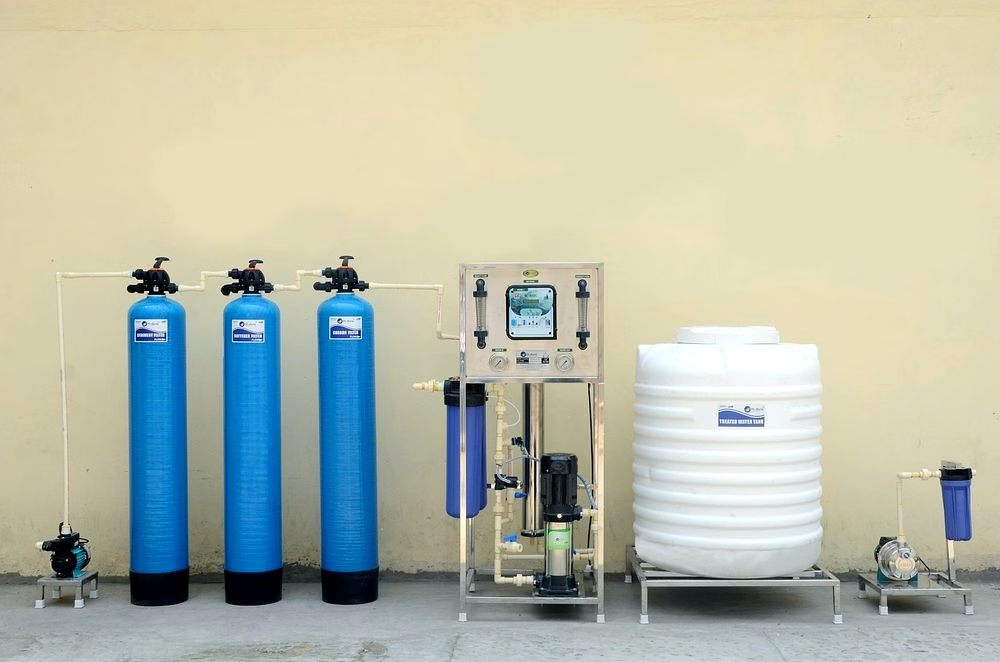
Structural Design and Material Composition of 1000 LPH RO Plants
The technical framework of the 1000 LPH Reverse Osmosis Plant utilize a structural 316L stainless steel skid that support a series-connected bank of pressure vessels and high-pressure axial pumps. The structural reasoning for the sanitary welding and hygienic valves is to eliminate "dead-legs"—areas of stagnant water where biofilm and gram-negative bacteria can proliferate. A failure in the hygienic seal—due to incorrect gasket selection—leads to "bacterial seeding," where microbes contaminate the entire permeate loop, potentially decommissioning a clinical dialysis ward. Measurement physics rely on the osmotic pressure differential; a failure in the high-pressure pump’s soft-start sequence results in "pressure hammer" events, which manifest as microscopic fractures in the membrane spacers, leading to irreversible salt passage. Every unit undergoes 100% factory hydrostatic testing at 1.5 times the operating pressure. Quality consistency is managed through serialized inspection logs that record permeate conductivity and flux at design temperatures. Without this metallurgical and structural integrity, the plant would suffer from localized pitting corrosion in chloride-heavy feedwaters, leading to system failure within the first 12 months of operation.
Functional Performance and Operational Efficiency in Preparatory Treatment
Operational efficiency is achieved through the unit’s integrated monitoring system, which tracks transmembrane pressure (TMP) and permeate conductivity in real-time. functional performance centers on the unit’s ability to maintain a stable rejection profile despite fluctuations in feedwater TDS. In real operational scenarios, a failure to monitor the "Silt Density Index" (SDI) leads to rapid membrane compaction—a failure mode that results in a catastrophic loss of permeate volume and requires the complete replacement of the membrane bank. The 1000 LPH plant utilize an automated flush logic that executes cleaning sequences based on measured operating hours or pressure differentials, effectively extending the interval between manual CIP (Cleaning-In-Place) procedures. If the control logic detects a quality excursion, it executes an automatic bypass to drain, preventing off-spec water from reaching the distribution loop—a critical safety standard for healthcare facilities. By maintaining a constant permeate head, the system improves the efficiency of downstream polishing stages, reducing the frequency of deionization resin replacement and effectively lowering the facility's total cost of ownership (TCO).
Institutional Deployment and Logistical Readiness for Hospital Supply
Designed for healthcare facilities, pharmaceutical laboratories, and industrial process plants, the 1000 LPH RO Plant is configured for the logistical requirements of multimodal multi-site procurement. Units ship on palletized stainless steel skids with shock-mitigation cushioning and moisture-barrier film to protect the delicate pressure vessels and instruments during transport. Failure to implement shock-monitored packaging can lead to "vessel misalignment," which results in O-ring leaks and potential bypass of the feed water upon site commissioning. For international procurement, supply-readiness is supported through lot-specific test certificates and technical specification dossiers (ISO/CE). Export-ready documentation include material declarations and wiring diagrams provided with each consignment to facilitate customs review and institutional asset registration. OEM private-label collaborations are supported, allowing buyers to standardize their control interface and branding across multiple regional facilities. This high-authority approach ensure the procurement team receives verified, installation-ready energy assets that meet the safety and performance standards of global water treatment markets, providing the transparency required for large-scale asset management and maintenance planning.
Frequently Asked Questions
- What performance testing is provided with each unit? Every unit includes a factory hydraulic test report documenting pressure, flow, and conductivity metrics.
- Can the system be configured for different electrical grids? Yes; motor starters and protection schemes are configurable to match regional 3-phase and single-phase supply rules.
- How is membrane life managed? Operating windows and recommended chemical-cleaning (CIP) intervals are provided; front-facing access simplify membrane exchange.
- What packaging protects the unit in transit? Skids ship on palletized bases with internal bracing, shock foam, and moisture-barrier liners to prevent mechanical and environmental damage.
- Which export documents are supplied? Shipments include lot-based inspection reports, a technical dossier, and certificates of conformity for customs review.
Description provided by Shakti Power Solutions Pvt Limited.
1000 Liters Per Hour (LPH)
Single Pass Reverse Osmosis
Removes dissolved salts, bacteria, and impurities
Industrial and Medical-grade water purification
Continuous and energy efficient
Low maintenance due to robust design
Corrosion resistant stainless steel construction
Shakti Power Solutions Pvt Limited
Specifications
Power Requirement
As per site specifications
Dimensions
Customizable as per installation site
Installation Type
Industrial/Commercial
Operating Pressure
Standard industrial R.O. pressure range
Warranty
Standard manufacturer warranty
Certification
Complies with industrial water treatment standards