Communication Architecture and Component Strategy of the MTL4850/54
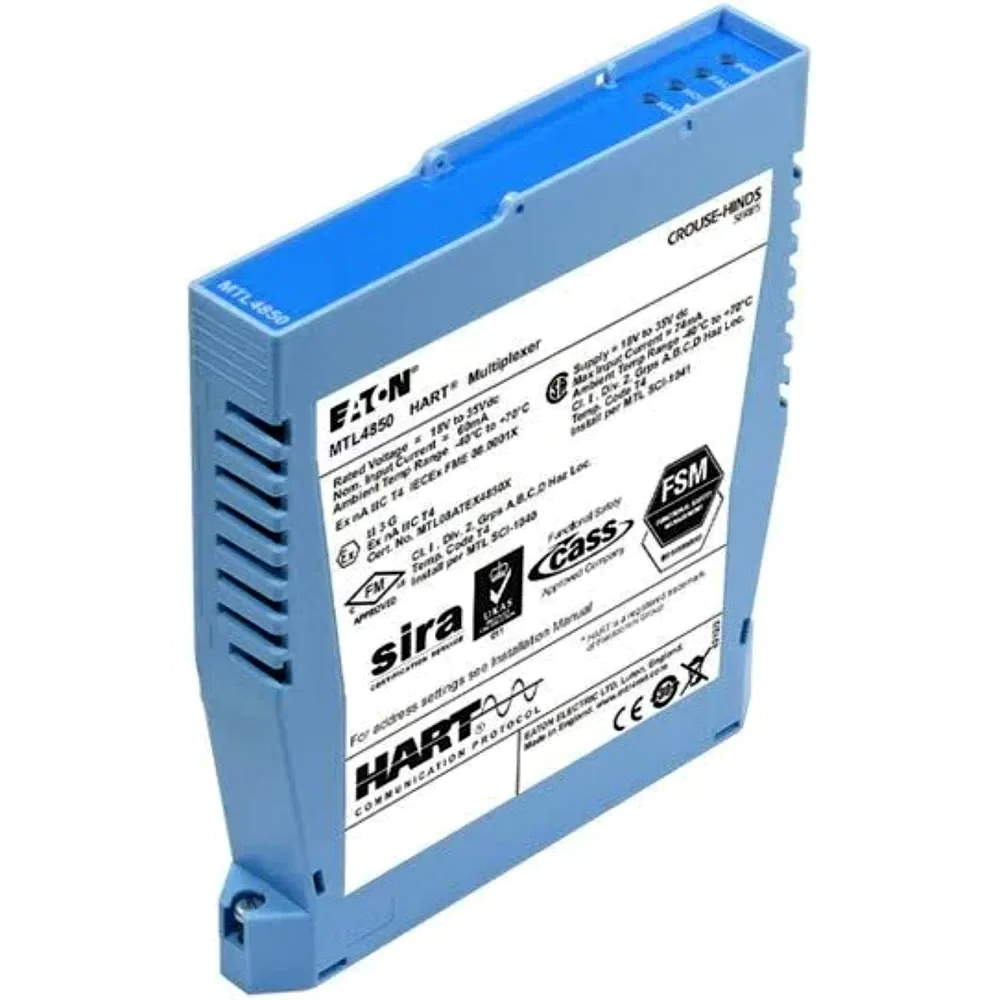
The technical framework of the MTL4850 and MTL4854 HART Multiplexers utilize a high-speed digital switching matrix coupled to isolated communication transceivers. The structural reasoning for the matched impedance networks is to minimize signal reflections—a failure mode known as "standing wave distortion" that results in corrupted HART commands and the inability to poll field instruments. Measurement physics rely on the opto-isolation between the supervisory bus and the individual field loops; if this isolation is breached—due to lightning surges or ground faults—a single faulty field device could decommission the entire multiplexer rail, leading to a total loss of visibility for the plant operators. The multiplexer logic utilize high-sampling-rate ADCs to extract the HART frequency-shift keying (FSK) signal from the 4–20 mA loop current. Quality consistency is managed through serialized configuration snapshots that record the gain and filtering parameters for every channel. Failure to management "channel crosstalk"—due to poor PCB shielding—results in "shadow commands," where a command sent to one transmitter is erroneously read by another, effectively decommissioning the control loop accuracy.
Functional Performance and Diagnostic Dynamics in instrument Networks
Operational efficiency is achieved through the unit’s ability to provide simultaneous multi-channel access, allowing AMS (Asset Management System) software to poll multiple transmitters during the same cycle. functional performance centers on the unit’s integrated diagnostics; the MTL4850/54 report FSK signal strength and signal-to-noise ratios for each loop. In a real operational scenario, a failure in a field cable—due to moisture ingress—results in reduced loop impedance; the multiplexer identifies this degradation before it triggers a SCADA alarm, allowing for event-driven maintenance. The unit supports remote configuration and "configuration dump" functions, enabling technicians to analyze the entire multiplexer state from the safety of the control room—a critical safety standard for safety-critical plants. If the multiplexer detects an internal logic fault or a power failure, it triggers a fault contact, notifying the DCS system immediately. Thermal management utilize heat-spreading materials to maintain component stability in dense marshaling cabinets. By providing isolated and aggregated communication, the multiplexer effectively improves the overall reliability of the instrument network, reducing the mean time to repair (MTTR) through its channel-specific fault indicators.
Institutional Deployment and Logistical Readiness for Export Processes
Suitable for control rooms, instrument marshalling panels, and multi-site industrial rollouts, the MTL4850/54 series is configured for the logistical requirements of multimodal procurement. Units ship in anti-static trays with moisture-barrier film to protect the sensitive internal processors and connectors during transit. Failure to implement finish-protected packaging results in localized oxidation of the gold-plated pins, manifesting as intermittent communication faults upon site commissioning. For international procurement, supply-readiness is supported through serialized configuration records and functional test certificates provided with each shipment (CE/UL). Export-ready documentation include technical specifications and installation checklists provided with each lot to facilitate regulatory review and institutional asset registration. Packaging utilize reinforced foam inserts to prevent mechanical misalignment of the modular connectors during multimodal transport. OEM options permit custom labelling and pre-configuration to minimize on-site setup time. This high-authority approach ensure procurement teams receive verified, site-ready instruments that meet the safety and performance standards of global industrial markets, providing the transparency required for institutional instrumentation tracking.
Frequently Asked Questions
- What diagnostics are available via the multiplexer? Each channel reports status, configuration state, and HART FSK signal strength metrics for remote troubleshooting.
- How is signal integrity maintained in long cable runs? Integrated matched impedance networks and isolation filters minimize reflections and reject common-mode noise.
- Are configuration snapshots provided? Yes; every unit ships with a configuration dump showing factory-set gain and filter parameters.
- What mounting options are supported? Modules can be installed in 19-inch racks or on standard 35 mm DIN-rails for marshaling cabinet integration.
- Can units be pre-configured for OEM rollouts? Yes, private-label branding and custom pre-configuration are available under controlled manufacturing agreements.
Description provided by Shakti Power Solutions Pvt Limited.
HART Multiplexers for continuous renal replacement therapy (CRRT) systems
Supports advanced Ci-Ca® regional citrate anticoagulation for high-risk patients
High-resolution 10.4 inch LCD with event storage up to 3,500 events
Integrates with multiDataLink for patient data management system (PDMS) connectivity
Operates on 100/120/230/240 V AC, 50/60 Hz with ~15 minutes emergency operation
175 cm (H) x 55 cm (W) x 60 cm (D), Weight approx. 100 kg
Features alarms limited to safety-related situations to ensure trouble-free operation
User-friendly, self-explanatory menu guides for ease of operation
Comprehensive training and cost-saving tailored disposables available
Specifications
Brand
Fresenius Medical Care
Size (H x W x D)
175 cm x 55 cm x 60 cm
Power Supply
100/120/230/240 V AC, 50/60 Hz
Emergency Operation
Approx. 15 minutes battery backup
Heating Capability
Up to 39°C for substitute and dialyser fluids
Display Type
10.4 inch high-resolution LCD
Event Storage
Up to 3,500 events
Communication Protocol
HART Multiplexer compatible
Anticoagulation Methods
Ci-Ca® regional citrate, Heparin options
Data Integration
Supports multiDataLink for PDMS connection


 FIEO Registered
Export Ready