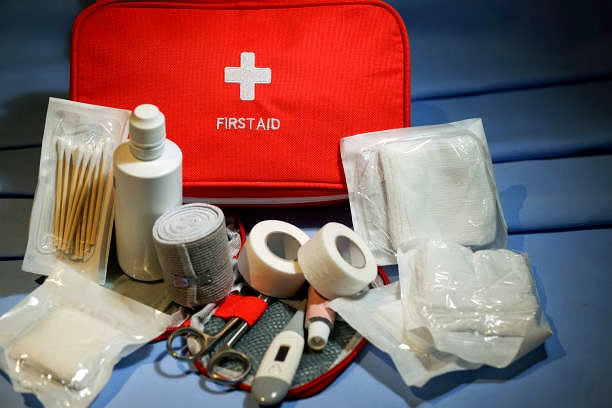
First Aid Kits

Indian Stalwart Global Sourcing Company
 FIEO Registered
Export Ready
FIEO Registered
Export Ready
Service Provider , Service Center, Manufacturer, Professional Services, Contractor, Retailer, Brand Owner, Distributor, Exporter, Importer, Wholesaler, Startup — Chennai, Tamil Nadu, India · Replies in ~24–48 hours
FIEO Registered
Export Ready
Price on request
/BAG
₹ 0.00
You save ₹ 0.00
In stock
Inclusive of all taxes
MOQ: 1 BAG
Lead time: On request
GST invoice
Origin: India
Export ready
Buyer protection
Interested in this product?
MOQ 1 BAG
Share your requirement and the seller will respond with a quote.
Comparing multiple suppliers?
Receive quotations from multiple verified suppliers and compare price & lead time.
Other buying options
Request sample — 0
Evaluate product quality before a bulk order.
Buyer-protected enquiry
Seller responds in ~24–48 hours
Freight & duties quoted separately
What similar products are available in this category?
Browse all →
Shalimar Super Enterprises
From $ 1.13
MOQ 1 Unit

Ayurbella
From $ 12.98
MOQ 100 Numbers
Ayurbella
From $ 5.40
MOQ 1 Numbers

Ayurbella
From $ 18.49
MOQ 1 Numbers

Ayurbella
From $ 5.94
MOQ 1 Numbers
Ayurbella
From $ 9.99
MOQ 3 Numbers

Nipa Genx Electronic Resources & Solutions
From $ 286.00
MOQ 1 BAG
Om Vriddhi India Private Limited
From $ 17.67
MOQ 1 Box