How to Get More Leads for Your Manufacturing Business (Including on AI Search)


Key Takeaways
-
Buyers increasingly ask AI tools like ChatGPT, Gemini, and Perplexity to shortlist suppliers before visiting a single website. If you're invisible to AI, you lose the inquiry before you know it existed.
-
Answer Engine Optimization (AEO) and its close cousin, Generative Engine Optimization (GEO) is about making your business easy for AI systems to find, understand and recommend.
-
Most manufacturers lose out not because of weak products, but because of thin product pages, missing certifications, inconsistent business listings and content that doesn't answer buyer questions directly.
-
Small, specific fixes, detailed product pages, a bank of Q&A content, verifiable proof, consistent business information and structured data make the biggest difference.
-
AI widens your funnel; it doesn't replace your sales team.
Generating leads for a manufacturing or export business has always meant a mix of trade shows, referrals, directories, and steady digital marketing. But a buyer looking for a valve manufacturer or a textile exporter today probably isn't scrolling through ten Google results anymore. They're asking AI tools like ChatGPT, Gemini, or Perplexity to shortlist suppliers for them, often before they've visited a single website. If your business doesn't show up in that shortlist, you've lost the inquiry before you even knew it existed.
This isn't a reason to panic or overhaul your marketing from scratch. Trade shows, referrals, and digital marketing still bring in business. But there's a new layer to how buyers research suppliers, and a few practical changes can make sure your business is part of that conversation, whether the buyer is searching on Google or asking an AI tool directly.
How Buyers Are Finding Manufacturers Today
A few years ago, sourcing a supplier meant typing keywords into Google and comparing websites one by one. Today, buyers are asking AI tools direct questions like:
-
"Who are the best sheet metal manufacturers in India?"
-
"Can you recommend reliable textile exporters?"
-
"Which Indian companies manufacture industrial valves?"
Instead of sifting through dozens of websites, buyers get a curated shortlist in seconds. If your company has a clear, consistent, well-documented online presence, AI is far more likely to include you in that shortlist. This is the essence of Answer Engine Optimization (AEO): making your business easy for AI systems to find, understand, and recommend. You'll also see this called Generative Engine Optimization (GEO) — the two terms are used almost interchangeably right now, and search engines themselves are still settling on which one sticks. Either way, the underlying work is the same, and it's worth showing up for both searches.
Why Many Manufacturing Businesses Are Invisible to AI
Most manufacturers we talk to have strong products and decades of experience. Their problem isn't credibility. It's visibility. AI tools can only recommend businesses they can understand, and several common gaps get in the way:
-
An outdated or thin website
-
Little detail about products, capabilities, or specifications
-
No case studies or customer success stories
-
Missing or unclear certifications
-
Inconsistent business information across platforms
-
Very little published content overall
Any one of these makes it harder for AI to confidently recognize your business as a trustworthy supplier. And confidence is exactly what determines whether AI recommends you or skips past you. Your products might be excellent, but if AI can't understand your website, it can't recommend you.
What "thin" looks like versus what "AI-ready" looks like
A few anonymized, composite examples make this concrete:
-
A precision components manufacturer had a product page that said "High-quality stainless steel fittings for various industries." An AI tool has nothing to latch onto here — no grade, no size range, no named industry. The AI-ready version names the grade (SS304/SS316), lists dimensional tolerances, and names three specific industries served (food processing, pharma packaging, marine hardware). The rewritten page is the one that shows up when a buyer asks an AI tool for "SS316 fitting suppliers."
-
A textile exporter had a homepage listing "cotton, linen, and blended fabrics" with no further detail. The AI-ready version breaks this into separate pages per fabric type, each with GSM ranges, weave types, and minimum order quantities. AI tools can now match a buyer's specific query ("120 GSM cotton poplin exporter") to an exact page, instead of a vague homepage.
-
An industrial valve maker had certifications mentioned once, in small print, on an "About Us" page. The AI-ready version lists the certification name and number directly on each relevant product page, next to the specification table. This is often the single detail that tips an AI tool from "possible match" to "confident recommendation."
The pattern across all three: specificity beats polish. A plainer page with exact numbers outperforms a beautifully designed page with vague language, because AI systems are matching on facts, not aesthetics.
Is Your Business AI-Ready? A Quick Self-Check
Answer yes or no:
-
Does every product page include exact materials, specifications, and tolerances not just "high quality"?
-
Are your industries served named specifically (e.g., automotive, oil & gas, pharma packaging) rather than "various industries"?
-
Are your certifications (ISO, CE, BIS, etc.) listed by name and number directly on relevant pages?
-
Is your business name, address, phone number, and website URL identical: same punctuation and formatting across your website and every directory or profile you're listed on?
-
Has your website been updated in the last 30 days with new content, a case study, or a spec update?
-
Do you have at least one detailed, verifiable case study or customer success story per major product line?
If you answered "no" to three or more, AI tools likely can't confidently recommend your business yet and that's usually the first thing worth fixing.
How to Make Your Manufacturing Business Easier to Discover
The goal is simple: help AI (and search engines) clearly understand who you are, what you make, and who you serve. Here's exactly where to start.
1. Rebuild your product pages around five specific elements
A product page with just a name and photo gives AI nothing to work with. Every product page should include:
-
Materials and specifications: Exact grades, dimensions, tolerances, not "high quality steel"
-
Industries served: Name them (automotive, oil & gas, pharma packaging) rather than saying "various industries"
-
Applications: What problem this product solves, in one or two sentences
-
Certifications: ISO, CE, BIS, or industry-specific marks, listed by name and number where possible
-
A clear enquiry or quote action: One obvious next step, not three competing buttons
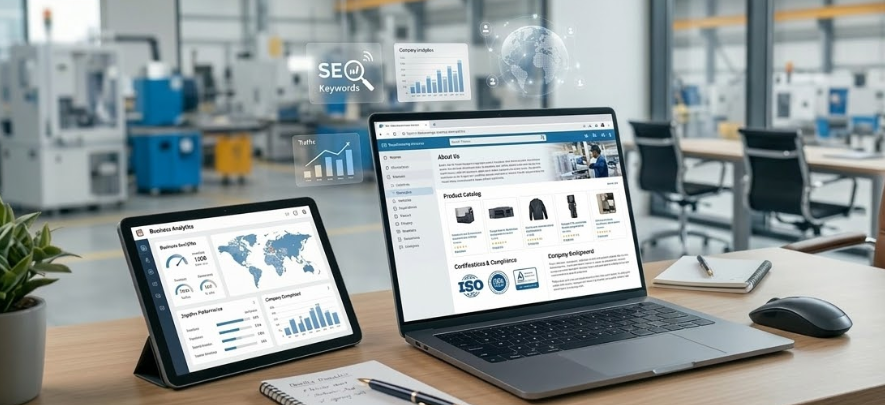
Aim for 300+ words of unique content per product page. Thin, templated pages that only swap out a product name are one of the fastest ways to lose AI's confidence. If your product pages are missing three or more of these elements, that's usually the first thing we fix in a Done-for-Me setup.
2. Build a bank of question-and-answer content
Buyers ask specific questions before they buy, and so do the AI tools researching on their behalf. For each core product line, publish short pieces (400–600 words) that open with the question as the heading and answer it directly in the first two sentences — this is the single biggest lever for AEO, since AI tools tend to lift the first direct answer they find.
Examples to build out:
-
How is [material] fabricated for [application]?
-
How do I choose the right [product type] for [use case]?
-
What certifications should I check before choosing an export supplier?
Structure each as: direct answer → supporting detail → link to the relevant product page.
3. Publish proof, not just claims
Case studies, testimonials, and certifications work harder than general marketing copy because they're verifiable. For each, include:
-
The client's industry (not name, if confidentiality is a concern)
-
The specific problem and the specific solution delivered
-
A measurable outcome (turnaround time, volume, cost saving)
Aim for at least one detailed case study per major product line or industry vertical, a page that reads as an actual account, not a testimonial quote box.
4. Get your business information identical everywhere
Pick one canonical version of your company name, address, phone number, and website URL, and use it exactly (same punctuation, same formatting) across your website, Google Business Profile, GlobalLinker profile, LinkedIn and any directory listing. Run a quick audit: search your company name and check the top 5 results side by side. Mismatches here are one of the most common, and most overlooked, reasons AI and search engines lose confidence in a business. This kind of cross-platform audit is exactly the sort of thing that's easy to miss on your own.
5. Keep the site visibly active
Set a simple cadence, even one update a month (a new case study, a product spec update, a blog post) and update the "last modified" date visibly where possible. A site that hasn't changed in two years reads as inactive to both crawlers and AI tools, regardless of how good the underlying content is.
6. Mark up your content so machines can read it, not just people
Behind the scenes, structured data (schema markup) tells search engines and AI tools exactly what they're looking at. At minimum:
-
Product pages need Product, Offer, and AggregateRating schema
-
Company/seller pages need Organization or LocalBusiness schema
-
Articles like this one need Article schema with author, organization, and published/updated dates
This doesn't change what a human sees on the page, but it's often the difference between AI treating your content as ambiguous versus authoritative. Structured data is technical by nature — it's usually the piece manufacturers skip, and the piece we set up for you as part of a Done-for-Me B2B Website & Digital Catalog Setup.
AI Isn't Replacing Your Sales Team
To be clear: AI won't close deals for you. Your sales team still does that.
What AI does is widen the funnel. It's another channel through which potential buyers discover your business before they've ever spoken to you. If your business is easy to understand online, AI has more reason to put your name in front of the right buyer at the right moment.
Want this done for you instead of DIY? See what's included in our Done-for-Me AI-readiness package →
Join a practical session on 16th July (Thursday) at 4:00 PM IST to learn more about making your business visible to AI. Register here →
FAQs
How do AI tools like ChatGPT find suppliers to recommend?
They pull from publicly available, well-structured content — websites, directories, and articles that clearly explain what a business does, who it serves, and how credible it is.
What is AEO (Answer Engine Optimization)?
AEO is the practice of structuring your online content so AI tools can easily understand and recommend your business in response to buyer queries. You may also see this called Generative Engine Optimization (GEO); the two terms describe the same practice.
How do I know if my website is invisible to AI?
Run the self-check above: if your product pages lack specific materials, named industries, and listed certifications, or your business details are inconsistent across platforms, AI tools are likely skipping past your business in favour of a competitor's clearer listing.
What's the fastest way to make my manufacturing business AI-discoverable?
The fastest way is our Done-for-Me AI-readiness package — we rebuild your product pages, standardize your business listings, add structured data, and publish the Q&A content AI tools look for, so you don't have to do it page by page yourself.
Do I need to redo my whole website to be discoverable by AI?
No. Small, consistent improvements — such as detailed product pages, consistent business information, and helpful content — make a significant difference.
Can AI replace my sales team?
No. AI helps buyers discover your business, but your sales team still builds the relationship and closes the deal.
Final Thoughts
Generating more leads isn't only about spending more on advertising. It's about making it easier for the right buyers to find you, wherever they're searching. As AI becomes a bigger part of how businesses research suppliers, manufacturers who invest in clear, trustworthy, and well-documented online content, with a digital catalog and B2B website built for AI discoverability, will have a real edge in being discovered and chosen.
The sooner you prepare your business for AI discovery, the more opportunities you create for future growth. Explore our Done-for-Me AI-readiness package → built for AI-powered discoverability.
Also read
HORECA Buyers' Glossary: MOQ, FOB, CIF and Lead Time Explained
Basmati Rice Grades Explained: A HORECA Buyer's Guide
Image generated by OpenAI
Disclaimer: The views and opinions expressed in this article are those of the author and do not necessarily reflect the views, official policy or position of GlobalLinker.
My endeavour is to help business owners digitise, network and grow easily. Towards this I help organise webinars, curate articles and answer queries via our help centre.