HORECA Buyer's Glossary: MOQ, FOB, CIF and Lead Time Explained for Sourcing from India

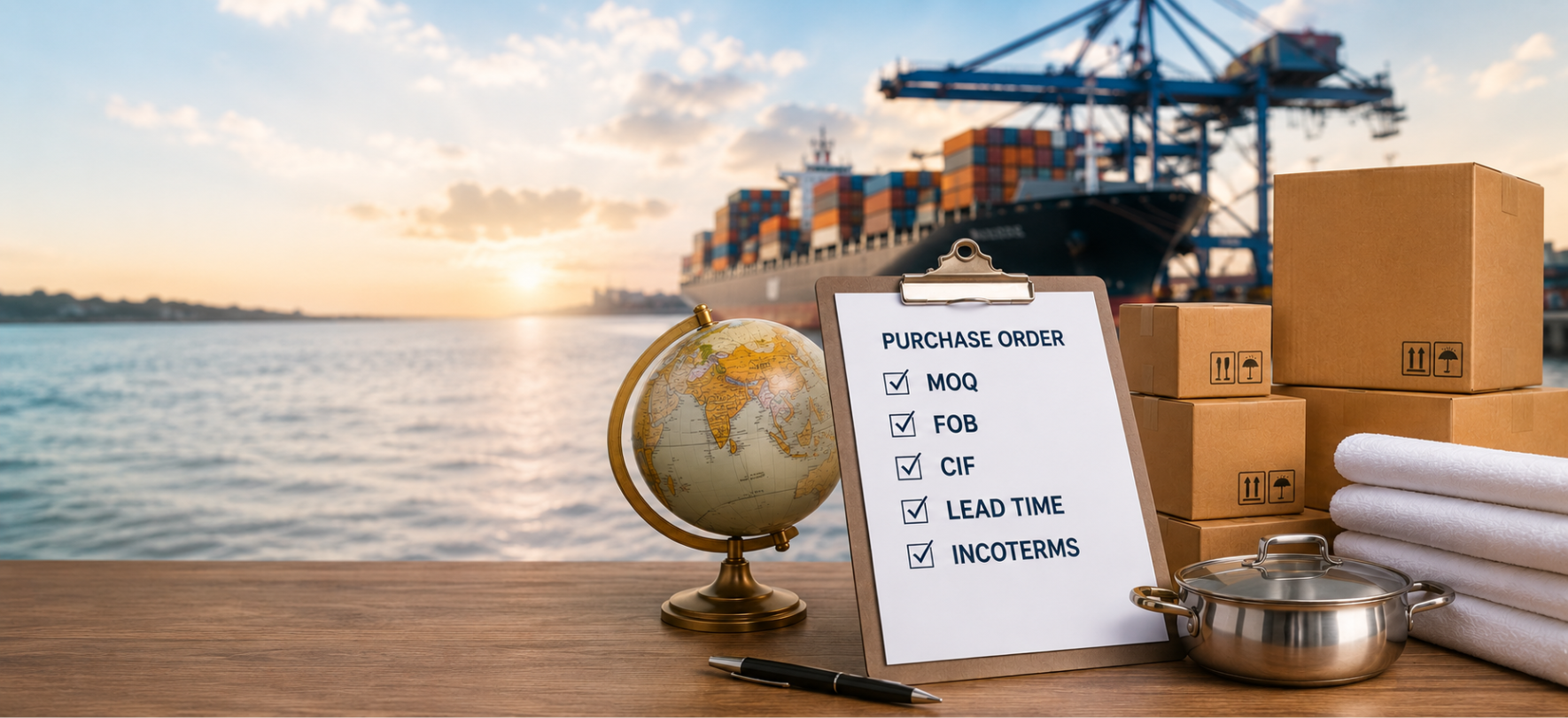
Every HORECA supplier quote is full of abbreviations: MOQ, FOB, CIF, lead time. These details decide almost everything that follows: how much stock you're committing to, who is responsible if something goes wrong in transit and when the shipment actually lands at your property.
HORECA buyers sourcing kitchen equipment, food ingredients, hotel linens or furniture from India run into this vocabulary on nearly every quote. This glossary decodes the terms that show up again and again, so you can read a quote accurately and negotiate with confidence.
Quick Reference: HORECA Procurement Terms at a Glance
|
Term |
Full Form |
What It Means for You |
|
MOQ |
Minimum Order Quantity |
The smallest quantity a supplier will sell in one order |
|
FOB |
Free On Board |
Seller's price ends once goods are loaded onto the ship |
|
CIF |
Cost, Insurance and Freight |
Seller's price includes shipping and insurance to your port |
|
EXW |
Ex Works |
Buyer handles everything from the factory or mill gate onward |
|
Lead Time |
N/A |
Days between placing your order and receiving the goods |
|
Incoterms |
International Commercial Terms |
The global rulebook that defines FOB, CIF, EXW and others |
Key Takeaways for HORECA Buyers
-
MOQ determines how much stock you must commit to, and directly affects your storage and cash flow planning.
-
FOB and CIF decide who pays for and manages ocean freight, not just how the price is calculated.
-
Lead time is rarely just "production time." It includes quality checks, documentation, and the actual shipping duration.
-
Comparing supplier quotes only works if they're all quoted on the same Incoterm, otherwise you're not comparing like for like.
-
Understanding these terms upfront prevents costly surprises after the purchase order is signed.
Minimum Order Quantity (MOQ)
MOQ is the smallest quantity of product a supplier is willing to sell in a single order. It exists because suppliers, whether that's a furniture manufacturer, a linen mill, or a food processor, have fixed costs per production run, packaging setup, and container loading that only make sense above a certain volume.
For a HORECA buyer, MOQ affects more than just your first order. It shapes how much storage space you need, how much capital gets tied up in inventory, and how often you can realistically reorder. A lower MOQ gives you flexibility but often comes at a higher per-unit price. A higher MOQ usually brings the price down but requires more warehouse space and a longer sales runway before that stock moves. This applies whether you're ordering bar stools from a hotel furniture supplier, table linens from a hotel linen supplier, or bulk spices from a food ingredient exporter.
What to ask suppliers: Is the MOQ negotiable for a long-term contract? Does it change with material, finish, or packaging format? Can it be split across multiple SKUs in one shipment?
A practical note: MOQ varies significantly by category, a kitchen equipment order and a hotel linen order won't follow the same minimums, and it's usually specified per listing on a supplier's product page rather than as a single blanket figure. Always check the MOQ for the specific product and supplier you're evaluating rather than assuming it's consistent across a marketplace.
FOB (Free On Board)
FOB is one of the most common terms you'll see in quotes from hotel supplies suppliers, kitchen equipment manufacturers, and food exporters alike, and one of the most misunderstood. Under FOB, the seller's responsibility, and their price, ends once the goods are loaded onto the vessel at the port of loading. From that point, the buyer takes on the cost and risk of ocean freight, insurance, and getting the shipment to their own port.
FOB is popular with experienced buyers because it gives them direct control over freight arrangements, often through their own freight forwarder, and because FOB prices are easier to compare across suppliers in different regions since freight costs aren't baked in.
Good for: buyers who already work with a freight forwarder or want to shop shipping rates independently of the supplier.
CIF (Cost, Insurance and Freight)
CIF extends the seller's responsibility further than FOB. Under a CIF quote, the supplier's price already includes the cost of shipping and marine insurance all the way to your named destination port. You still handle customs clearance and inland transport once the shipment lands, but the ocean leg is the seller's problem.
CIF is often the more convenient option for buyers who are new to importing or don't have an established freight forwarder relationship. The tradeoff is usually a bit less control over which carrier is used and when the shipment actually departs, since the supplier is managing that end of the process.
Good for: First-time importers or buyers who prefer a simpler, all-in quote over managing freight themselves.
FOB vs CIF: Which Should You Choose?
Neither term is universally better, it depends on your operational setup.
-
Choose FOB if you have freight forwarding relationships and want to control shipping costs and timing directly.
-
Choose CIF if you'd rather have one supplier handle the shipping arrangement and want fewer moving parts to manage.
Either way, always confirm which Incoterm a quote is based on before comparing prices between suppliers. A supplier quoting FOB and another quoting CIF for the same product can look wildly different on paper, but once freight and insurance are added to the FOB price, the real cost may be nearly identical.
Lead Time
Lead time is the total time between placing your purchase order and the shipment actually arriving at your destination port. It's rarely just about how fast a factory can produce goods, whether that's furniture, linens, or packaged food. A realistic lead time typically includes:
-
Production or processing time
-
Quality control and inspection
-
Packaging and export documentation
-
Customs clearance on both ends
-
Actual transit time by sea or air
For HORECA buyers, underestimating lead time is one of the most common causes of menu disruptions and last-minute substitute sourcing. Building in a buffer, and reordering before stock runs critically low, matters more than chasing the fastest quoted lead time.
A real-world example: Shipping from India to the UAE by sea typically takes 10 to 14 days, while shipping to the UK by sea runs closer to 18 to 25 days. Air freight is faster but pricier, generally 3 to 5 days to the UAE and 5 to 7 days to the UK. These figures cover ocean or air transit only, so add production time, quality checks, and customs clearance on both ends to get a realistic door-to-door lead time.
What to ask suppliers: Does the quoted lead time start from order confirmation or from deposit payment? Does it account for peak season delays or port congestion?
Other Common Terms You'll See in HORECA Procurement
Incoterms: The internationally recognized rulebook, published by the International Chamber of Commerce, that defines terms like FOB, CIF, EXW and others. Incoterms specify exactly where cost and risk transfer from seller to buyer, which is why quotes almost always reference one.
EXW (Ex Works): The seller's price covers only the goods themselves, made available at their factory or warehouse gate. The buyer arranges and pays for everything from that point onward, including export clearance. It's the lowest-responsibility option for the seller and generally requires the most experienced buyer to manage well.
A practical note: many supplier listings and marketplace price sheets quote EXW by default, since it's the simplest baseline for a seller to publish. If you want a true landed cost comparison, always ask the supplier for a CIF or DDP quote rather than assuming the listed EXW price is close to what you'll actually pay once freight, insurance, and duties are added.
DDP (Delivered Duty Paid): The opposite end of the spectrum from EXW. The seller handles everything, including shipping, insurance, customs clearance, and destination duties, delivering the goods ready for pickup at your door.
HS Code (Harmonized System Code): A standardized product classification code used by customs authorities worldwide. It determines duty rates and is required on almost all export documentation.
Bill of Lading: The shipping document issued by the carrier that serves as proof of the contract of carriage and, in most cases, is required to release the goods at the destination port.
Port of Loading and Port of Discharge: The port of loading is where the goods leave the exporting country. The port of discharge is where they arrive in the buyer's country. Both are named explicitly in FOB and CIF quotes.
Why This Glossary Matters for HORECA Buyers
If you're sourcing kitchen equipment, hotel furniture, linens, or bulk ingredients from India, these terms show up on nearly every quote and contract you'll receive. A hotel furniture supplier quoting FOB Mumbai or a bulk food supplier quoting CIF Jebel Ali is telling you exactly where their responsibility ends and yours begins. Getting comfortable with this vocabulary makes it easier to compare quotes accurately across categories, negotiate MOQ and lead time with confidence, and avoid the kind of miscommunication that leads to delayed shipments or unexpected costs at customs.
For buyers working with hotel supplies suppliers or kitchen equipment suppliers in India, it's also worth asking directly which Incoterms they typically quote under, since this can vary by category, region, and even by product line.
Frequently Asked Questions
What does MOQ mean in export trade?
MOQ stands for Minimum Order Quantity, the smallest amount of product a supplier is willing to sell in a single order. It's set by the supplier based on production costs and container loading efficiency.
What is the difference between FOB and CIF?
Under FOB, the seller's responsibility ends once goods are loaded onto the ship, and the buyer arranges and pays for shipping and insurance. Under CIF, the seller's price already includes shipping and insurance to the buyer's named port.
Which is better for a new importer, FOB or CIF?
CIF is often easier for first-time importers since the supplier manages the shipping arrangement. FOB gives more control and can be more cost-effective for buyers who already work with a freight forwarder.
What does lead time include besides production?
Lead time typically includes production time, quality inspection, packaging, export documentation, customs clearance, and the actual transit period by sea or air, not just manufacturing time alone.
Why do supplier quotes list different Incoterms?
Suppliers may default to whichever Incoterm is standard for their region or product category. Buyers should always confirm the Incoterm on a quote before comparing prices across suppliers, since freight and insurance costs are included differently under each term.
Can MOQ be negotiated?
Often, yes. Suppliers may lower MOQ for buyers committing to long-term contracts, recurring orders, or higher order values, though this varies by product and production setup.
What is a Bill of Lading and why does it matter?
A Bill of Lading is the shipping document issued by the carrier that proves the contract of carriage and is generally required to release the shipment at the destination port. Without it, customs clearance can be delayed.
How long does shipping from India to the UAE or UK typically take?
Sea freight from India to the UAE generally takes 10 to 14 days, while sea freight to the UK takes about 18 to 25 days. Air freight is faster, roughly 3 to 5 days to the UAE and 5 to 7 days to the UK, though it usually costs more. These figures cover transit time only, so total lead time will be longer once production and customs clearance are factored in.
Final Thoughts
Reading a supplier quote shouldn't feel like decoding a foreign language. Once you understand MOQ, FOB, CIF, and lead time, along with a handful of supporting terms like Incoterms and HS codes, comparing suppliers and negotiating terms becomes far more straightforward. For HORECA buyers sourcing equipment, hotel supplies and ingredients from India, this vocabulary isn't just background knowledge, it's the difference between a smooth procurement process and one full of avoidable surprises.
Also read
Top Food Products Exported from India for the Hospitality Industry: A Complete HORECA Sourcing Guide
Halal Food Sourcing from India: A Complete Guide for GCC Buyers
What Do Indian Food Export Certifications Mean for International HORECA Buyers?
How to Evaluate a Commercial Kitchen Equipment Supplier from India: HORECA Buyer's Guide
Basmati Rice Grades Explained: A HORECA Buyer's Guide to Sourcing from India
How to Get More Leads for Your Manufacturing Business (Including on AI Search)
Image generated by OpenAI
Disclaimer: The views and opinions expressed in this article are those of the author and do not necessarily reflect the views, official policy or position of GlobalLinker.
My endeavour is to help business owners digitise, network and grow easily. Towards this I help organise webinars, curate articles and answer queries via our help centre.