Toy Certifications in India: A Complete Guide for Manufacturers and Exporters

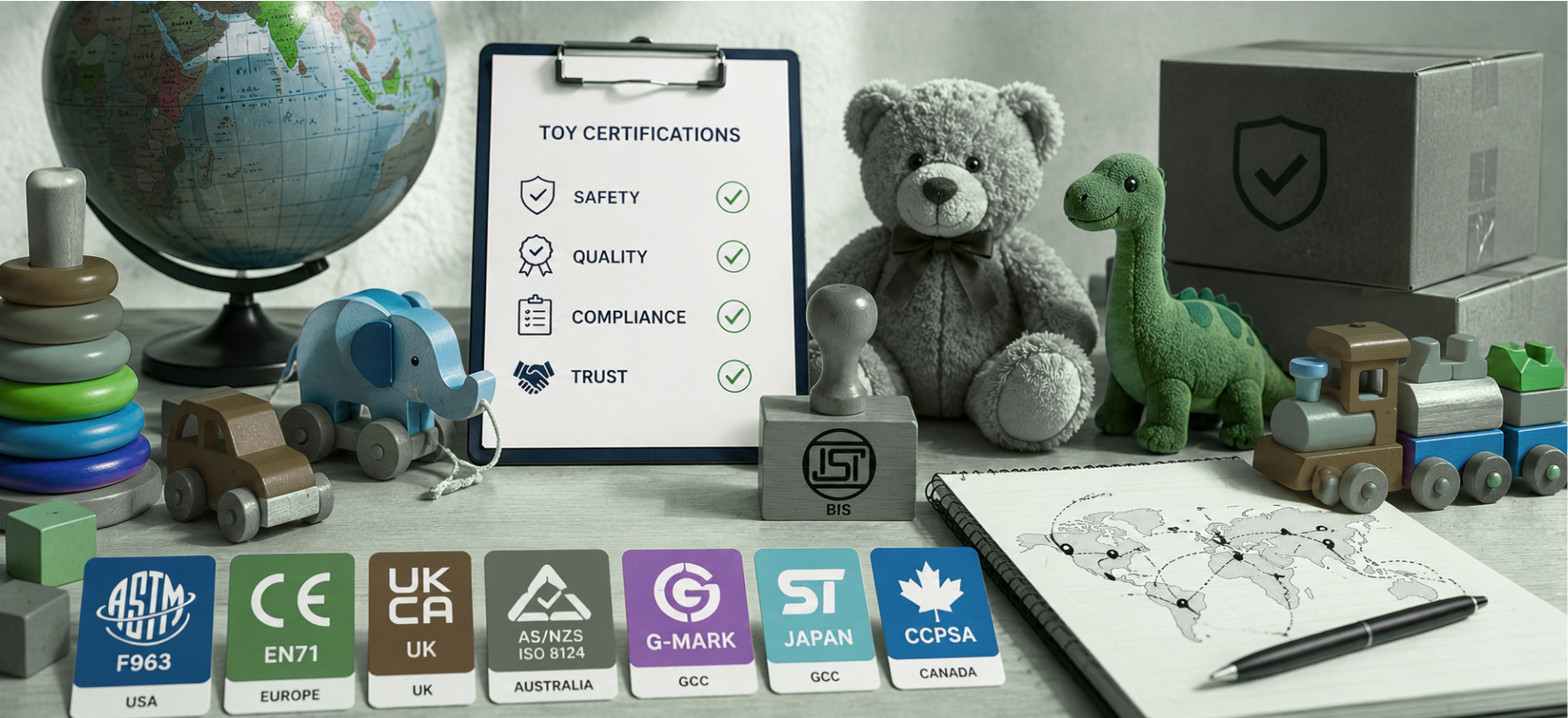
If you manufacture or export toys from India, certification isn't optional paperwork — it's what determines whether you can legally sell at all, and in which markets. This guide breaks down exactly what's mandatory for operating in India, what's required to export to specific countries, and what's simply good practice for building buyer trust.
Use this as a working reference before you list your products, apply for certification, or respond to a buyer's compliance query.
1. Mandatory Certification to Manufacture or Sell Toys in India
No matter which market you eventually plan to export to, this is your starting point. You cannot legally manufacture, import, or sell toys in India without it.
BIS Certification (ISI Mark)
Under the Toys (Quality Control) Order, 2020, issued by the DPIIT (Ministry of Commerce and Industry), every toy meant for children under 14 — electric or non-electric — must carry the ISI mark before it can be sold in India. This applies to domestic manufacturers and to foreign manufacturers importing toys into India.
Standards that apply:
-
IS 9873 (Part 1–9) — for non-electric toys (mechanical, physical, chemical, flammability safety). Recently updated as IS 9873 (Part 1):2025, bringing Indian standards closer to global ISO benchmarks.
-
IS 15644:2006 — for electric toys (electrical safety).
-
FMCS (Foreign Manufacturers Certification Scheme) — mandatory for any overseas manufacturer exporting toys into India.
A few things every seller should know:
-
Certification is granted per manufacturing unit and per toy type — if you make both electric and non-electric toys, or manufacture at more than one facility, you'll need separate applications.
-
License validity now extends up to 5 years under Scheme-II (previously renewed annually), reducing the compliance burden.
-
Artisans registered with the Office of the Development Commissioner (Handicrafts) are exempt from this order — relevant if you sell handcrafted wooden or traditional toys.
-
BIS certification is also mandatory to list toys on any e-commerce platform in India, including Amazon and Flipkart.
-
Non-compliance isn't just a listing risk — it can result in product seizure, penalties, and criminal liability.
Bottom line: BIS is your license to operate in India. It is not, however, your license to export. That's a separate requirement, covered next.
2. Mandatory Certification by Export Market
This is where most first-time exporters get caught out — assuming BIS certification is sufficient for international buyers. It isn't. Each destination market has its own mandatory toy safety regime, and your buyer's customs authority will check for it independently of your Indian certification.
|
Export Destination |
Mandatory Certification |
What It Covers |
|
United States |
ASTM F963, CPSIA compliance, CPC (Children's Product Certificate) |
Lead content, phthalates, small parts/choking hazard — testing must be done via a CPSC-accepted lab |
|
European Union |
CE Marking + EN71 (Parts 1, 2, 3) |
Mechanical/physical properties, flammability, chemical migration |
|
United Kingdom |
UKCA Marking |
Post-Brexit equivalent of CE for the UK market |
|
Australia / New Zealand |
AS/NZS ISO 8124 |
Toy safety standard aligned to ISO |
|
Canada |
CCPSA compliance |
Canada Consumer Product Safety Act requirements |
|
GCC (UAE, Saudi Arabia, etc.) |
G-Mark (GCC Conformity Mark) |
Regional conformity mark across GCC states |
|
Japan |
ST Mark (Japan Toy Association) |
Not government-mandatory, but functions as one — most retailers will not stock uncertified toys |
Practical guidance for exporters: Certify for the markets you're actually targeting, not every market at once. If your buyer base is entirely US-focused, EN71/CE adds cost without commercial benefit — and vice versa. Ask your buyer, or check the destination country requirement, before commissioning testing.
3. Category-Specific Considerations
Certain toy categories carry additional certification expectations beyond the base mandatory requirements:
-
Soft toys, plush toys, and fabric-based toys: Chemical safety of the textile itself matters as much as the toy structure. Buyers in the EU and US frequently expect Oeko-Tex Standard 100 alongside standard toy safety certification.
-
Toys with organic textile claims:GOTS (Global Organic Textile Standard) certification is expected if organic cotton or fabric claims are made on packaging or listings.
-
Wooden and handcrafted toys: May qualify for the BIS handicrafts exemption, but international buyers will still expect evidence of non-toxic paint/finish compliance (EN71 Part 3 chemical migration, in particular).
-
Electronic/battery-operated toys: IS 15644 domestically; internationally, expect additional electrical safety scrutiny (e.g., EN62115 in the EU) alongside general toy safety marks.
4. Good-to-Have (Optional) Certifications
These aren't legally required in India or in most export markets, but they meaningfully strengthen your position with buyers — particularly larger retail chains and repeat B2B buyers who assess suppliers holistically, not just product-by-product.
Optional in India:
-
ISO 9001 (Quality Management System) — signals consistent manufacturing process control
-
ISO 8124 — voluntary in India, but demonstrates alignment with the international toy safety benchmark
Optional but increasingly expected by export buyers:
-
Sedex / SMETA audit — social and ethical compliance audit; many large retail buyers (particularly in the US and EU) treat this as a soft prerequisite even when not legally mandated
-
WCA (Walmart Compliance Audit) — relevant if targeting large-format US retail buyers specifically
-
Oeko-Tex Standard 100 — for textile-based toys, even where not the buyer's primary market requirement
-
GOTS — where organic claims are part of your product positioning
Why these matter even though they're optional: A buyer choosing between two BIS-and-EN71-certified suppliers will often default to the one with a Sedex or ISO 9001 certification on file, simply because it reduces their own due-diligence burden. Voluntary certification is a differentiator, not a formality.
5. Quick Reference: What to Have Ready Before You List or Export
-
BIS (ISI Mark) — non-negotiable for any sale within India
-
Destination-market certification matching each country you export to (see Section 2)
-
Category-specific documentation (chemical/textile safety, electrical safety, as applicable)
-
Test reports from accredited/recognized labs, not just the certificate itself — buyers will ask for both
-
Optional certifications relevant to your target buyer type (retail chains vs. independent importers)
Keeping this documentation current and organized on your seller profile reduces back-and-forth with buyers and speeds up order confirmation — particularly for first-time buyers evaluating your credibility before placing an order.
Frequently Asked Questions
Is BIS certification mandatory for all toys sold in India?
Yes. Under the Toys (Quality Control) Order, 2020, all toys for children under 14 — electric or non-electric — must carry the ISI mark before sale, whether domestically manufactured or imported.
Does BIS certification allow me to export my toys internationally?
No. BIS certification only confirms compliance with Indian safety standards. Each export market has its own mandatory certification — for example, ASTM F963/CPSIA for the US or CE/EN71 for the EU — which must be obtained separately.
Which certification do I need to export toys to the United States?
ASTM F963 compliance along with CPSIA documentation and a CPC (Children's Product Certificate) issued after testing at a CPSC-accepted laboratory.
Which certification do I need to export toys to the European Union?
CE Marking, supported by test reports confirming compliance with EN71 (Parts 1, 2, and 3), covering mechanical, chemical, and flammability safety.
Do soft toys or plush toys need any certification beyond standard toy safety marks?
Yes. Fabric-based toys often additionally require Oeko-Tex Standard 100 certification for textile chemical safety, especially for EU and US buyers.
Is ISO 9001 or Sedex/SMETA certification required to export?
Not legally required, but many international retail buyers request these as part of their supplier evaluation process, even when not mandatory under law.
How long is a BIS certification valid?
Under the current Scheme-II provisions, BIS licenses for toys are valid for up to 5 years, with renewal required at expiry.
Are handmade or artisan toys exempt from BIS certification?
Products sold by artisans registered with the Office of the Development Commissioner (Handicrafts) are exempt from the Toys QCO. However, export buyers may still expect chemical/paint safety documentation.
What happens if I export without the destination country's mandatory certification?
Shipments can be held or seized at customs, and buyers may face import rejection — which typically falls back on the exporter as a compliance failure, affecting future order relationships.
This guide is for general informational purposes and reflects certification requirements as understood at the time of publishing. Regulations are periodically updated — please verify current requirements with BIS, your export market's regulatory authority, or a certification consultant before making compliance decisions.
Also read
Are Indian Wooden Toys Safe? BIS, ASTM F963, and EN71 Certification Explained
How to Source Private-Label Toys from India: MOQ, Customization, and Lead Times
Image generated by OpenAI
Disclaimer: The views and opinions expressed in this article are those of the author and do not necessarily reflect the views, official policy or position of GlobalLinker.
SMEs are our partners & my focus is to provide value, experience in their quest for growth and opportunities. This drives us to improvise our feature offerings and enhance our bouquet of services on the platform.